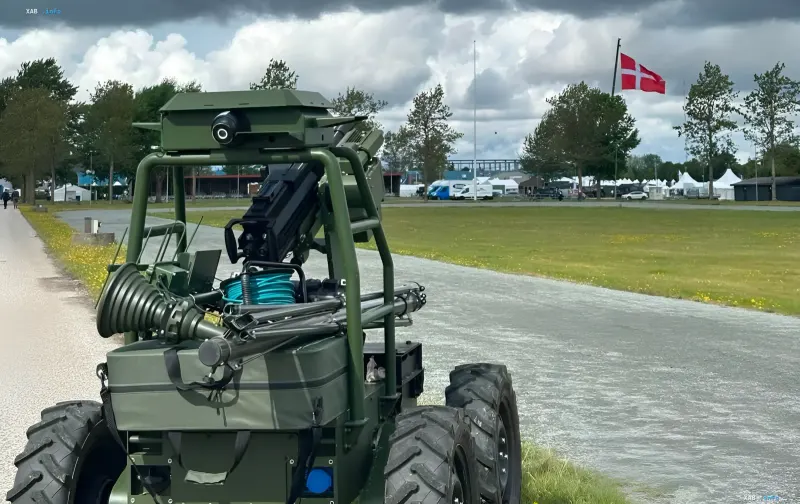
Denmark hosted the DALO Industry Days defense and industrial exhibition — one of the key events in the defense sector with a focus on the Nordic countries. The platform brings together military personnel, procurement officials, manufacturers, and international partners, creating a space for direct negotiations on cooperation. According to Roksolana Svinchuk, head of the international direction at the Ukrainian Council of Arms Manufacturers, the event confirmed that interest in Ukrainian defense technologies among Danish and Scandinavian partners already exists; however, the main task now is to turn this interest into real long-term partnerships, rather than a series of working meetings without concrete commitments.
The "Danish Model" and a New Level of Cooperation
Denmark holds a special place in the context of Ukrainian-Scandinavian defense cooperation. It was here that the so-called "Danish model" was formed — a mechanism for directly financing purchases from Ukrainian manufacturers for the needs of the Ukrainian Armed Forces. Other countries subsequently joined this mechanism. According to Svinchuk, it became clear at DALO Industry Days that cooperation is moving to the next level: it is no longer just about procurement, but about the localization of Ukrainian manufacturers on Danish territory, joint production, the attraction of private capital, and the establishment of direct links between companies without intermediaries.
Combat Experience as a Competitive Advantage — and Its Limits
Ukrainian manufacturers possess a unique asset that cannot be quickly reproduced in laboratory conditions: their solutions are developed in direct interaction with the military, tested in real combat conditions, and continuously refined based on actual use. It is precisely this "combat track record" that makes Ukrainian technologies attractive to foreign customers. However, as the expert emphasizes, the European market evaluates not only the product but the company as a whole. Partners are interested in compliance procedures, certification, documentation, corporate structure, the reliability of supply chains, and the ability to scale production. Particular attention is paid to the origin of components and the degree of dependence on supplies from third countries.
A Dual Challenge: Speed and Institutional Maturity
Ukrainian manufacturers have to solve two tasks simultaneously. On the one hand, they must maintain the speed of development and the balance between price and effectiveness — the very advantages that have become the hallmark of Ukrainian defense tech. On the other hand, they must build a business ready for the requirements of the international market and foreign government regulatory frameworks. A product successful in Ukraine does not automatically find its place in Denmark: it requires an understanding of local needs, security challenges, procurement rules, and the regulatory requirements of a specific market. You need to sell not only the technology and its combat experience, but also the specific value for the new customer, and be ready to adapt the product to local conditions.
Participant Case Studies and Partnership Models
DALO Industry Days featured companies at various stages of entering the Danish market. Dropla Tech, MITS Industries, and Fire Point already have practical experience working in Denmark; Fire Point, in particular, shared "lessons learned" on launching production on Danish territory. Twist Robotics and eDrone presented their solutions, discussed their developments, and described what they are looking for in future partnerships. There is no single scenario: for some, a joint venture model is optimal; for others — joint production; for still others — direct sales or working with a local manufacturer. But in all cases, as Svinchuk summarizes, strong technology is only the beginning of the journey.
Business Culture and Honesty as a Condition for Long-Term Partnership
A separate aspect of working with Danish partners, the expert notes, is taking into account the local business culture: directness, honesty, and a clear understanding of the purpose of the conversation are especially valued here. If a company is looking for an investor, a production partner, or entry into government procurement, it is better to speak concretely from the start. The earlier partners honestly define their capabilities, expectations, and limitations, the lower the chance that cooperation will remain at the level of a few meetings and general mutual interest. The partnership must be clear to both sides: what each of them brings, who invests, where production will be located, who the future customer is, and what the cooperation should look like in a few years. The state, even at an unprecedented level of support, cannot be the sole source of financing for every project — customers, local partners, private investment, and a business model that will work even after the completion of a specific support program are needed.