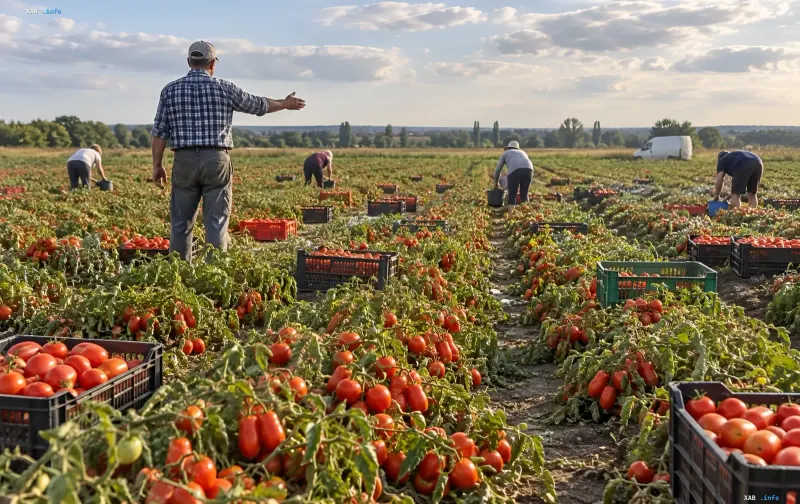
Ukrainian farmer Andrii Kalynichenko faced a dilemma familiar to anyone who grows vegetables on a large scale: the crop had ripened, but there were not enough hands to pick it. Rather than let the tomatoes rot in the field, he offered a simple, seemingly obvious solution — inviting anyone willing to come to the field and harvest the crop themselves. The price was just 10 hryvnia per kilogram. The video with the offer, published on TikTok, gathered over a million views and became one of the most discussed agri-themed posts of the week. However, instead of unanimous support, the farmer's initiative sparked a heated debate in which two fundamentally different views on the value of agricultural labor collided.
How the self-harvest idea came about
According to the Styler outlet (an RBC-Ukraine project), Kalynichenko decided not to wait for someone to come to the field with a purchase offer, but to reach out to the audience himself. In the caption of the video he wrote succinctly: "SELF-HARVEST. Slivka, round tomatoes for juice and fermentation. 10 UAH/kg." The varieties in question are traditionally used for home preserves — making tomato juice, fermentation, and canning. These are not premium salad tomatoes, but a working product that is difficult to sell in large volumes through regular retail channels without significant logistical and time costs. The farmer, in essence, offered the consumer to take on part of the logistics and labor, and in return receive the product at a minimal price that merely covers the cost of growing it.
The price that split the internet
It was the figure of "10 hryvnia per kilogram" that became the trigger for the hottest part of the discussion. A significant portion of commenters perceived the offer as an undervaluation of the farmer's labor. Comments argued that growing a crop requires investing one's own money in seeds, fertilizers, and equipment, spending months of time, and working physically in the field all season. "Why is a peasant's labor valued so cheaply? It's a real shame!" wrote one participant of the discussion. Another commenter suggested that critics try growing tomatoes themselves: "Good tomatoes — whoever writes that it's expensive, let them grow some, invest their own money, work for several months, and then they can say whether it's expensive or not." A separate wave of criticism came from those who considered even 10 hryvnia an inflated price. One user drew a comparison with the price of a pack of cigarettes: "We have some interesting people: a pack of cigarettes for 150 UAH is normal, but tomatoes at the price of a cup of tea are expensive."
Contradictory data
In the discussion around the video, a discrepancy emerged in estimates of the market value of tomatoes, making it impossible to definitively determine whether a price of 10 hryvnia per kilogram is low or high. On the one hand, a significant part of the audience believes that 10 hryvnia is an undervaluation, since it does not account for the farmer's full costs: sowing, care, harvesting, storage, and sale. On the other hand, another group of users claims that even this price is inflated. In particular, one participant of the discussion stated that at her local market tomatoes had already been harvested and were being sold for 8 hryvnia per kilogram. Thus, in the public space two incompatible positions exist simultaneously: for some, 10 hryvnia is "cheap peasant labor," for others it is "expensive, at the bazaar it's 8 hryvnia already harvested." The 2-hryvnia difference between these two estimates, for all its apparent insignificance, reflects a deeper divergence in understanding what is included in the price of the final product: the cost of growing it, or the full market price taking into account logistics, storage, and middlemen markups.
Reaction and practical interest
Despite the wave of criticism, under Kalynichenko's video there were quite a few users who were genuinely interested in the offer from a practical standpoint. Comments actively asked exactly where the field was located, how to get there, and what address to enter into the navigation. Some wrote outright that they were ready to come and pick the tomatoes themselves. This indicates that for part of the audience the "self-harvest" format is not only economically advantageous but also attractive as a way to get a fresh product straight from the garden bed, bypassing intermediaries. For the farmer, such a model allows him to realize a volume that otherwise would have to be either left in the field or sold to wholesalers at a substantial discount.
Context: farm labor and price perception
The situation with Kalynichenko's tomatoes is not an isolated case. It fits into a broader context of the discussion about how Ukrainian society perceives the value of agricultural products and the labor of those who produce them. On the one hand, the consumer expects low prices on basic products. On the other — farmers, especially small and medium ones, operate in conditions where the cost of production (fuel, fertilizers, equipment, labor) is rising faster than the final market price. The self-harvest format proposed by Kalynichenko is, in essence, an attempt to bypass this gap: the farmer hands part of the work over to the consumer, and the consumer receives the product at a price close to the cost of production. The success of the video — over a million views — shows that the topic finds wide resonance, and the arguments in the comments reflect not just a reaction to a specific price, but a deeper tension between consumer expectations and the real economic conditions of agricultural producers.