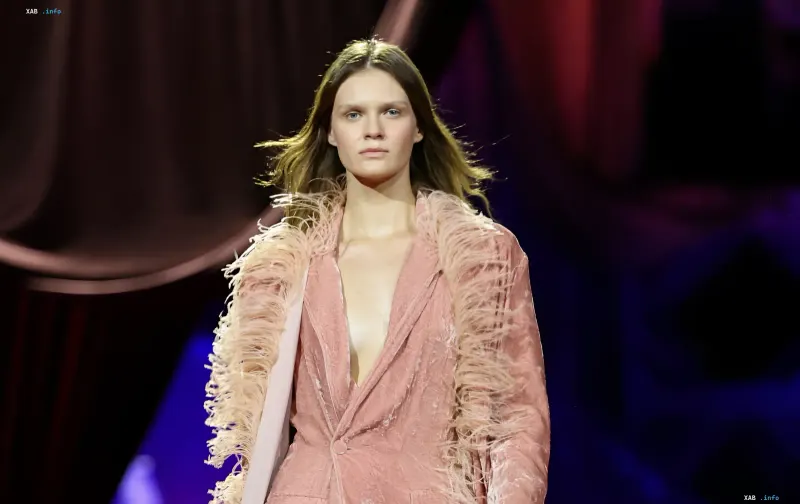
The 59th season of Ukrainian Fashion Week has concluded in Kyiv. Held from September 2 to 6, it became one of the most unusual in the history of the Ukrainian fashion industry. Designers presented their Spring–Summer 2027 collections at the Mystetskyi Arsenal and at iconic locations across the capital; however, the air-raid alerts issued one after another in the city did not merely accompany the programme — they effectively rewrote it, with part of the shows being forced to move into shelters. In this way, the runway of this season became, on such a scale for the first time, part of the everyday reality of war, not just a showcase of aesthetics.
Business Conference and Panel Discussions
The season opened on September 2 with the Ukrainian Fashion Week x white rabbit agency business conference, "New Rules of the Game: Strategies for Sustainability and Real Sales 2026/27," held at the TUM in Kyiv. Despite a series of air-raid alerts, all three planned panel discussions took place. Representatives of the fashion business discussed changes in the behaviour of the Ukrainian consumer, domestic sales, brands' expansion into international markets, and the link between marketing and commercial results.
Theatrical Scale: From the Opera House to the Railway Station
The season's first runway appeared outside the traditional world of fashion: the COAT by Katya Silchenko presented its Opera collection at the National Opera of Ukraine. The starting point was the transformation of the role of women from the Victorian era to the present day, with historical silhouettes combined with contemporary constructions, sporty details, and transparency. One of the dresses used more than 50 corset structures, and one jacket was hand-assembled from more than 15 types of lace. The opera house itself, having survived destruction and remaining a place of art, created a parallel with modern Ukraine. The following day, J'AMEMME chose the Red Hall of Kyiv's Central Railway Station, where architecture, light, music, and the models' movements became part of a performance about female strength.
Debuts and Performances
The second day was marked by the debuts of BALYKINA and SYNDICATE in the official UFW programme. The SYNDICATE show ended with a water performance: under its effect, the final look gradually dissolved, revealing the inscription "I'm Here." That same day, GRAINS DE VERRE, KACHOROVSKA, and PASKAL also presented their new collections.
Adaptive Design and Cultural Resistance
The third day was perhaps the most accurate reflection of this UFW's reality. JULIYA KROS presented RECONSTRUCTION — a collection created after the brand's production facilities in Sumy were destroyed — and continued to develop her adaptive line for people with various physical disabilities. Kristina Rahetska, in her "Opir/Opора" (Resistance/Support) collection, turned to the traditional shirts of Opolia, Pokuttia, and Bessarabia, using age-old silhouettes and hand embroidery as a way to speak about memory and cultural resistance. VIKTORANISIMOV created a collection inspired by photographs of people after Russian missile and drone attacks on residential buildings; it was during his final show that an air-raid alert was issued, and the designer presented the collection directly in a shelter. That same day, PRZHONSKA, GURANDA, DANIA STINOVA, and leCRI presented their collections, and the BOB BASSET team returned to Kyiv.
Shelters as a New Venue
The next day the situation repeated itself: due to an alert, the shows by VOROZHBYT&ZEMSKOVA and DARJA DONEZZ took place in a shelter. This season's shelter effectively became yet another venue of Ukrainian Fashion Week — not a design decision, but a forced part of Ukrainian reality. In a conversation with Wave RBC.UA journalist Ivanna Pashkevych, VOROZHBYT&ZEMSKOVA designers Olena Vorozhybit and Tetyana Zemskova explained the position of those who consider fashion "out of place" during a war: people need the ability to keep living, working, and creating, and if the industry freezes in gloom, then cakes, shows, and the very life of the nation will disappear too.
Contradictory Data
The main body of facts (the 59th season, the dates of September 2–6, the SS27 collections, the designers and venues listed) is consistent within the source text. At the same time, the metadata of one of the verification sources (obozrevatel.com) contains the phrasing "after 2.5 years of full-scale war" in its headline, which chronologically does not match September 2026 (by that point the full-scale war has been going on for about four and a half years). This is most likely an outdated or inaccurate editorial phrasing in the source's headline; it does not change the substance of the events, but the discrepancy in the figures is recorded for transparency.
The outcome of the 59th season was a demonstration that Ukrainian fashion is adapting to the conditions of war not at the level of declarations but at the level of real decisions: from moving shows into shelters to adaptive design and collections born out of destroyed production facilities. The runway this season became both a showcase and a document of the era.