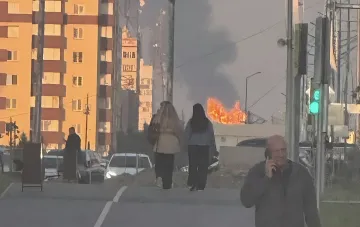
Ukraine's defense forces continue to strike oil refining facilities and military infrastructure on Russian territory. According to RBC-Ukraine, President Volodymyr Zelensky stated this, emphasizing that Ukrainian military forces "continue to respond justly to Russian strikes on Ukraine." Among the targets hit, he named oil refineries in the Ryazan and Perm regions and Tatarstan, as well as a storage and launch site for strike drones in the Kursk region and a target in the Black Sea.
President's Statement: List of Struck Facilities
"An oil refinery was hit in the Ryazan region. Our long-range forces were used against oil refineries in the Perm region and Tatarstan, as well as against the storage and launch sites of strike drones in the Kursk region," the head of state said. According to him, an enemy target in the Black Sea was also struck. Thus, a single statement mentions three oil refineries, a strike UAV operations node, and a maritime target, indicating that efforts are distributed across several directions simultaneously.
Ryazan Refinery: Scale and Significance of the Target
The Ryazan refinery, according to the data cited in the report, is one of the largest in Russia: its annual processing capacity is estimated at approximately 17 million tons of crude oil. The plant produces motor gasoline, diesel fuel, aviation kerosene and other petroleum products, including, as noted, for the needs of the Russian army. Earlier, on September 6, Ukrainian drones, according to a reminder in the text, struck the plant's largest primary crude oil processing units with a capacity of 8.5 million tons per year. The facility, according to available information, is subjected to attacks regularly: at the end of July, the defense forces had already struck its territory, after which fires broke out in Ryazan at the refinery and at a Wildberries marketplace facility, and the region's governor confirmed the fire at industrial sites.
Series of Strikes on Oil Refining Infrastructure
The report of new strikes on refineries fits into a broader series of attacks on energy and logistics infrastructure recorded in August. In particular, in early August there were reports of strikes on a refinery in Saratov, a military air base in Engels, and another Wildberries warehouse; later — of a strike on the Novokuybyshevsk refinery and, for the first time, an Ozon marketplace warehouse in Samara Oblast. The totality of these episodes shows that oil refineries and associated facilities have remained a consistent target of strikes over several weeks.
Contradictory Data
When comparing statements and publications from the same period, a discrepancy arises in the geographical list of struck refineries. In Zelensky's statement (citing RBC-Ukraine) from early September, the plants in the Ryazan and Perm regions and Tatarstan are mentioned. At the same time, August summaries (Euronews, Pravda.com.ua) emphasize strikes on refineries in Saratov, Novokuybyshevsk (Samara Oblast) and facilities in Engels. In other words, the exact set of regions named in connection with attacks on oil refining capacity varies depending on the date and source; some of these events relate to different episodes, while others may reflect different wordings of the same strikes. Independent confirmation of each specific facility from the president's statement is absent in the provided materials.
Context and Positioning
The Ukrainian side positions these strikes as a retaliatory response to Russian attacks on Ukrainian territory. The emphasis on "long-range force" and on the simultaneous striking of targets in several regions and at sea indicates an attempt to demonstrate the scope and depth of strike capabilities. For the Russian side, such strikes on refineries affect not only military supply but also civilian infrastructure, making the topic sensitive from both a military and an economic agenda perspective.