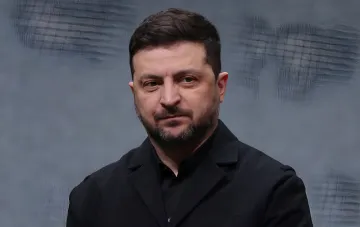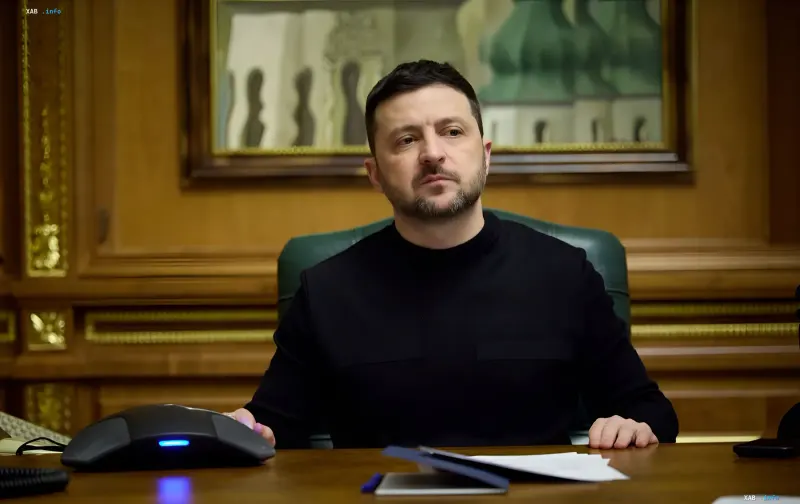
Ukrainian President Volodymyr Zelenskyy has stated that the country is working on increasing the range of its own missiles and unmanned aerial vehicles to extend their striking impact to more remote territories of Russia. According to RBC-Ukraine, the head of state announced this during a briefing on the results of the so-called 'deep strikes' conducted in September and October. He noted that Russian facilities 'on the line from Yamal to Western Siberia' are within the reach of these strikes, as he phrased it, and work to expand the impact radius is ongoing.
Report on 'Deep Strike' Results and the Term 'Long-Range Sanctions'
Zelenskyy reported that he received a briefing following the deep strikes in September and October, thanking the military for their 'accuracy' and 'regular high-quality implementation of Ukrainian long-range sanctions' — terms he uses to describe strikes on distant targets. 'Every Russian strike on our cities and communities is always met with our entirely fair response. Today, Russian objects on the line from Yamal to Western Siberia are within the reach of our deep strikes, and we are working to ensure our drones and missiles can reach even more remote Russian territories,' the president stated. Thus, he framed the expansion of strike range as a retaliatory response to attacks on Ukrainian populated areas.
Scaling Up Units and Involved Structures
According to Zelenskyy, key directions for the future application of 'long-range sanctions' have already been determined. He announced that the units carrying out such strikes 'will be scaled up' — based both on the capabilities of the Security Service of Ukraine (SSU), specifically the 'Alpha' Special Operations Center, and on intelligence agencies and other components of the defense forces. The president emphasized that, in his estimation, long-range capability is one of the 'real guarantees for preserving Ukraine's independence during the war' and, as he put it, will be one of the long-term security guarantees after peace is achieved.
The Night of October 30: Moscow Airports and Novokuybyshevsk Refinery
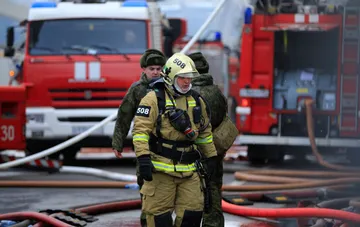
The president's statements came against the backdrop of the events of the night of October 30. According to available data, a massive drone attack caused widespread disruptions at Moscow airports, with over 200 flights canceled due to the drone raids. In addition, that same night, drones attacked Novokuybyshevsk in Russia's Samara Oblast; the strike triggered a fire on the grounds of a local petrochemical enterprise that produces jet fuel for Russian aviation. These episodes formed part of the overall picture of nighttime strikes mentioned in the report cited by Zelenskyy.
Significance of Statements and Context
The public pinpointing of specific geographical landmarks — from Yamal to Western Siberia — and the announcement of expanded structures carrying out the strikes make this statement one of the most specific in Kyiv's public rhetoric regarding long-range striking capabilities. At the same time, all operational details — the list of targeted objects, actual range, and strike outcomes — are presented from the perspective of the Ukrainian leadership and are not accompanied in the provided materials by independent verification from Russian authorities. For observers, a key question remains: how effectively the announced 'scaling up' of units and expansion of the impact radius will be implemented in practice, and how air defense systems in vast remote territories will respond.