
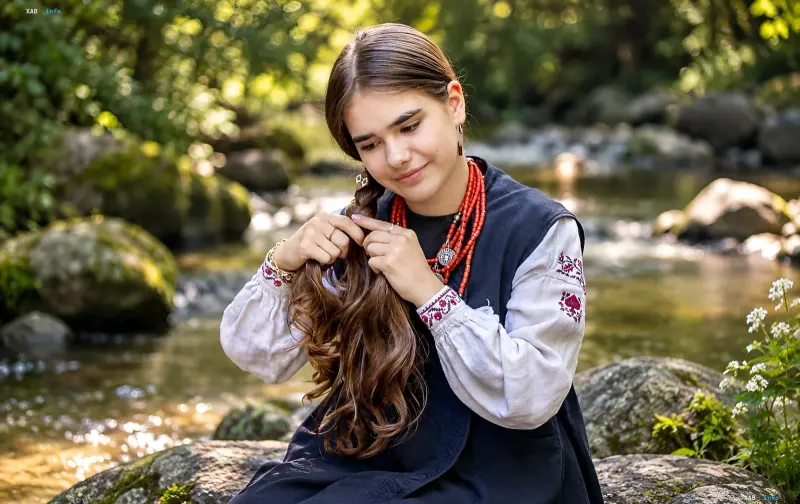
In traditional Ukrainian culture, hair occupied a special, almost sacred place. It was associated with a person's beauty, health, and vitality, which is why a whole set of unwritten rules and taboos developed around haircutting, combing, and being touched by outsiders. These concepts formed over centuries and can be traced through family rituals, wedding traditions, and folk beliefs about magical influence. Today, when most of us view hair primarily as an element of appearance, it is useful to turn to ethnographic sources and understand the source of the caution our ancestors felt toward strange hands reaching for their locks.
Hair as a Carrier of Vital Energy
According to ethnologist Halyna Bondarenko, in traditional Ukrainian beliefs, hair was considered a medium of magical influence and maintained an inseparable connection with its owner. This is why any intervention by an outsider was perceived as a potential threat. People did not use other people's combs and did not lend their own, fearing that through this simple everyday object, part of their life energy could be transferred or stolen. Hair was viewed as a “reservoir” of strength: its damage or use in magical rituals, according to popular beliefs, could negatively affect the owner's well-being and destiny.
Envy, the Evil Eye, and “Ill Intentions”
Special wariness was caused by the touches of those whom a person did not trust. In popular beliefs, envy and malevolence were considered a real source of the evil eye, and hair was seen as the most vulnerable channel for such influence. It was believed that a person with bad intentions could “take away” part of life's energy simply by touching the locks or, even more dangerously, by cutting them off and keeping them in a secret place. Ethnologist Andrii Temchenko describes beliefs in his research according to which cut strands could fall into the hands of a witch who, according to folk beliefs, used them to exert magical influence on the victim's health. Hence the strict ban: never leave cut hair just anywhere, but burn, bury, or keep it in a place inaccessible to outsiders.
The Braid as a Symbol: From Girlhood to Marriage
In traditional Ukrainian culture, a girl's braid was not just a hairstyle, but a powerful cultural symbol of youth, beauty, and health. The hairstyle also served as an indicator of marital status: unmarried girls wore loose or braided hair, and after the wedding, their hair was covered with a headdress. In wedding rituals, the unbraiding of the hair and the covering of the bride's head symbolized the end of girlhood and the transition to a new stage of life. Concepts of fertility, female strength, and the cyclical nature of life were tied to hair, making it an even more “forbidden” zone for outside eyes and hands.
From Superstitions to Cultural Heritage
It is important to emphasize: there is no scientific evidence that touching hair can take away vital energy, transmit negative energy, or change a person's destiny. All described consequences exist exclusively within the framework of folk beliefs and are not confirmed by any modern scientific methods. Nevertheless, these ideas are a valuable part of Ukrainian cultural heritage, reflecting the worldview, value system, and concepts of personal boundaries in a traditional society.
Personal Boundaries: A View Without Mysticism
Even if we discard all superstitious interpretations, unwanted touches to the hair or head violate a person's personal boundaries. The right not to allow outsiders to touch one's head does not require magical justification: it stems from the basic principle of respect for bodily autonomy. Thus, the ancient Ukrainian ban on strangers' hands in the hair, no matter how mystical its original justification, ultimately coincides with the modern norm of polite behavior and respect for another person's personal space.