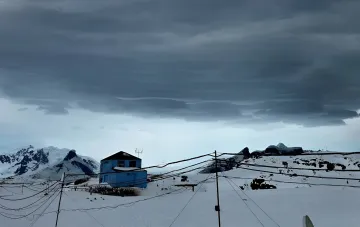
Ukrainian polar researchers working near the Akademik Vernadsky station have documented a rare atmospheric optical phenomenon: iridescence in cirrus clouds. According to the press service of the National Antarctic Scientific Center (NASC), as reported by RBC-Ukraine, the images captured at the station show an irregular, colorful patch in the sky over the icy continent, resembling a massive "soap bubble" in shape and shimmer. Scientists emphasize that such sightings in polar latitudes occur irregularly and depend on the precise combination of solar incidence angles, cloud altitude, and the size of the ice crystals that compose cirrus clouds.
The Physics of a 'Soap Bubble': Light Diffraction and Interference
As explained by the NASC, iridescence is an optical effect resulting from diffraction, where sunlight bends around small obstacles and penetrates behind them. In the case of cirrus clouds, these obstacles are microscopic ice crystals. After bending around the crystals, light waves overlap, causing interference—creating the colorful shimmers that form the characteristic rainbow "film" on the cloud background. Importantly, the colors in iridescence are always distributed unevenly, following the cloud's internal structure, which makes each observation unique and asymmetrical.
Why Cirrus Clouds are the Ideal 'Screen' Environment
Cirrus clouds belong to the upper troposphere. In polar regions, they "live" at altitudes of 4–6 km, where air temperatures drop to -20 °C or lower. At such altitudes, water in the clouds exists primarily as delicate ice plates and needles. Cirrus clouds are known for their lightness and high transparency, which is why the colorful "play" of light on their surface is particularly distinct. The NASC notes that it is precisely this transparency and fine crystalline structure that make cirrus clouds optimal objects for observing iridescence in polar conditions.
Iridescence vs. Coronas and Halos: The Fundamental Difference
The NASC press release specifically highlights that iridescence must be distinguished from two other atmospheric optical phenomena: coronas and halos. Unlike iridescence, coronas and halos have a clear circular shape and are symmetrical relative to the light source, though they differ in radius. Iridescence, however, lacks strict symmetry; its color patches are asymmetrical and "tethered" to the cloud's texture. Furthermore, the NASC points out that iridescence is more commonly observed on the edges of lower- and mid-level clouds, which are generally opaque but possess transparent fringes where the diffraction effect becomes visible.
Context of Observations at Akademik Vernadsky
This recorded iridescence is just one episode in a series of unusual atmospheric and astronomical observations regularly conducted by Ukrainian polar researchers near the Akademik Vernadsky station. Previously, the station team reported recording a historic temperature record, as well as the appearance of a reddish aurora and two neighboring galaxies visible simultaneously in the night sky over Antarctica. All photos and videos are published publicly on the NASC Facebook page, allowing the scientific community and the general public to monitor atmospheric dynamics in one of the planet's most remote and least-studied regions.