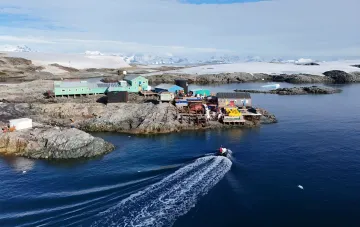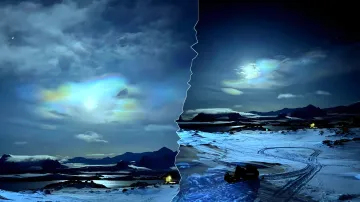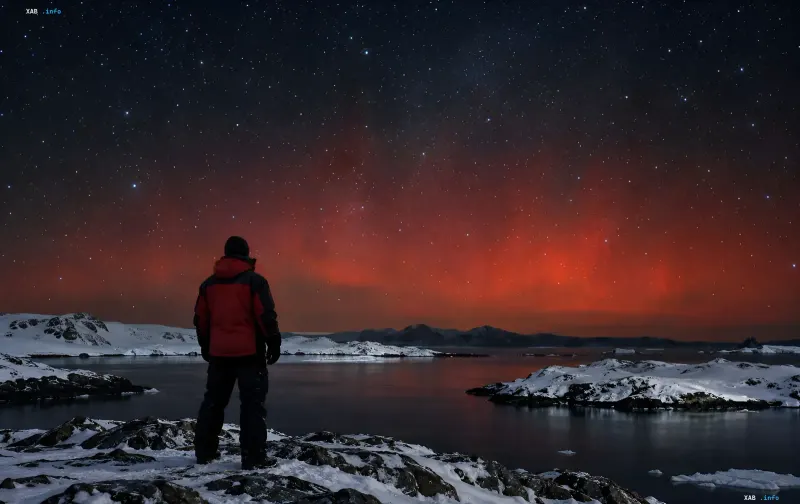
Ukrainian polar researchers working near the Academic Vernadsky station in Antarctica have captured a rare night sky phenomenon: a reddish aurora borealis against which two neighbouring galaxies are clearly visible. This was reported by RBC-Ukraine, citing a joint publication by the press service of the National Antarctic Scientific Center (NASC) and Universe Space Tech on Facebook.
Why the Aurora Appeared Red
The NASC recalled that in the public consciousness, auroras are typically associated with the colour green, yet this atmospheric phenomenon can display a wide variety of shades. Specialists explained that the coloration depends on the types of gases in Earth's atmosphere interacting with charged particles and on the altitude at which the process occurs. When high-energy solar wind particles reach the upper atmosphere, they transfer energy to gas atoms and molecules, which in turn emit light. «Red and green shades are primarily linked to the emission of oxygen itself,» the center emphasized. At altitudes above 200 km, atomic oxygen often produces a red glow, whereas green predominates at lower levels.
Two Galaxies in a Single Frame
In addition to the aurora, two blurred, light-colored nebulous patches among the stars are visible in the images — the Large and Small Magellanic Clouds. According to experts, these are dwarf galaxies that serve as satellites to our Milky Way. The Large Magellanic Cloud is located approximately 160,000 light-years from Earth, and the Small is about 200,000 light-years away. Under favorable conditions, both galaxies can be observed with the naked eye in the Southern Hemisphere. «These frames combine phenomena of completely different scales: the aurora occurs hundreds of kilometers above Earth, while the light of the Magellanic Clouds traveled through space for hundreds of thousands of years before reaching the camera lens,» the publication noted.
Who Took the Photo and Where
The photographs capturing both phenomena were taken by meteorologist-ozonometrist Serhii Yakushchenko from Galindez Island in Western Antarctica. It was from this vantage point that he managed to capture the moment when the reddish aurora arc and distant galaxies aligned in the same field of view.
Context: The Sixth Antarctic Season
As a reminder, the Ukrainian research vessel Noosphere has already begun its sixth Antarctic season. The mission plans to expand the geography of research and international cooperation. It was also previously reported that the crew for the Academic Vernadsky station has been formed and that a unique protected area was established in Antarctica on Ukraine's initiative.