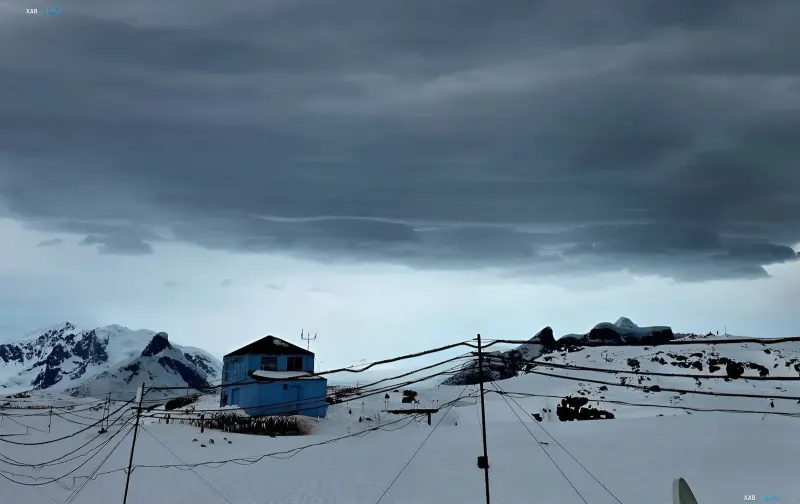
Ukrainian polar explorers working near the Vernadsky Research Base (Galindez Island) have recorded an all-time temperature record for October. According to the National Antarctic Scientific Center (NASC), published on its official Facebook page and reported by RBC-Ukraine, the recorded figure became the highest for all years of observations in this month. The anomaly occurred on the evening of October 18: the air temperature rose from +1.2°C to +11.1°C — an increase of almost 10 degrees in just two and a half hours.
Historical October maximum and its place in the general scale
The new figure surpassed the previous October record set at the station earlier. At the same time, NASC emphasizes that the absolute highest temperature ever recorded by Ukrainian scientists near Vernadsky is +12.7°C — this maximum was registered in February 2022. Specialists note that the difference between the general and October maximums is small, only 1.6°C. “However, it should be taken into account that we are talking about different seasons,” stated Denys Pyshniak, head of the Department of Atmospheric and Geospace Physics at NASC, explaining that February is “the height of the Antarctic summer,” whereas October is merely “the beginning of spring.”
The mechanism of the anomaly: the mountain Foehn wind
According to experts, the cause of the sudden warming was the so-called “mountain Foehn” — a dry, warm wind from the mountains. This effect occurs when a flow of warm and moist air rises over a mountain ridge: in the area of the station, these are the peaks of the Kyiv Peninsula, opposite which Galindez Island and the Vernadsky station are located. As it rises, the air loses moisture, forming clouds and precipitation, while heat is released during condensation. Having overcome the peak, the flow descends, compresses, and heats up additionally. “This creates a warm, dry stream that leads to a sharp increase in temperature and the melting of glaciers,” NASC explained. In general, Foehn winds are a typical phenomenon for this area of Antarctica.
The “atmospheric river” and the context of climate change
Experts link the intensification of the Foehn wind this time with another meteorological phenomenon known as an “atmospheric river.” These are narrow bands with a high concentration of atmospheric moisture which, according to specialists, have increasingly penetrated from the tropics into polar regions in recent years, carrying large amounts of warm, moist air. NASC points out that this is one of the consequences of climate change actively studied by the center's scientists. Thus, the coincidence of the region's typical mountain Foehn with an abnormally humid stream produced a cumulative effect, leading to a record temperature spike.
Visual confirmation: lenticular clouds and dark storm clouds
Simultaneously with the warming, the center's meteorologists observed lenticular clouds over the mountains, which specialists note are frequent companions of mountain Foehns, forming from the moisture that the air stream loses at the mountain peak. The published photographs also show the source of extreme heat — dark clouds over the mountains from which, according to NASC estimates, heavy precipitation was likely falling at that moment. These observations visually confirm the described mechanism: the condensation of moisture on the windward side of the ridge and the subsequent dry, heated descent of the flow on the station's side.
Context: station operations and the Noosphere research vessel
The recorded anomaly became part of Ukraine's ongoing scientific research activities in Antarctica. It was previously reported that the Ukrainian research vessel Noosphere has begun its sixth Antarctic season, aiming to expand the geography of research and international cooperation. Data on temperature, humidity, and cloud cover collected by polar explorers near Vernadsky, including during such anomalies, are used to study climate dynamics in polar regions.