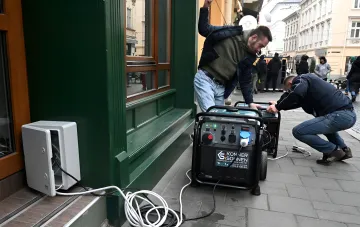
Ukraine's HoReCa sector is entering the new 2026 heating season with fundamentally different requirements for energy independence than a year ago. If in previous winters establishments could get by with three to four hours of diesel generator operation to weather a planned or emergency grid power outage, the power supply system must now withstand one to two full days without grid power. The shift from "short outages" to prolonged blackouts has radically changed the structure of capital and operational costs in the restaurant business, turning the generator from a safety net into a critically important piece of infrastructure.
Capital Expenditure: From 1.5 to 4 Million Hryvnias
According to data from the La Famiglia chain, a small establishment requires a generator with a capacity of 150–200 kW to ensure independence, while a large restaurant or chain needs up to 275 kW. Capital expenditures, including the purchase of the generator, automatic transfer switches, connection, and full installation, range from 1.5 to 2 million hryvnias for a small restaurant and from 2 to 4 million hryvnias for a large establishment. These figures reflect the cost of "entering the season" for each individual location, not for the entire chain, which makes the burden on small and medium business budgets particularly significant.
Operational Burden and the Profitability Threshold
A month of operation in autonomous mode costs the chain 200,000–400,000 hryvnias regardless of the scale of the establishment — from a small café to a large restaurant. Restaurant expert Olha Nasanova names a clear economic threshold: after 5–6, at most 7 hours of continuous generator operation, further operation of the establishment simply does not pay for itself. This means that even with equipment capable of lasting 1–2 days, the economic viability of running on diesel drops sharply within the first day. The business is effectively forced to balance between the physical ability to operate and the financial logic in which each additional hour of generator operation erodes the margin.
Contradictory Data
In the public discourse surrounding the 2026 winter season, there are conflicting estimates of the impact of energy independence on consumer prices. On one hand, the industry is circulating the claim that "the generator has raised prices by 17%." On the other hand, expert Olha Nasanova directly dismisses this figure, stating that the actual growth in the average check is 5–10%, and its main drivers are the rising cost of food items and staff salary increases, not the cost of generator operation. Thus, the question of what exact share of the check increase is attributable to energy independence remains a matter of debate: some market players attribute greater weight to the generator than industry analysts confirm.
Lessons from the Previous Season and Equipment "Safety Margin"
In the previous heating season, generators mass-failed precisely during peak load hours — when kitchen equipment, air conditioning, and refrigerated chambers were all switched on simultaneously. This time, chains are building a "safety margin" into their purchases to avoid repeating the scenario where a location is left without power at the most critical moment. In addition, in certain locations, nighttime generator operation is prohibited due to noise levels, which forces establishments to purchase additional accumulators for refrigerated chambers capable of maintaining temperature without external power. In effect, the business is paying twice: for fuel during the day when the generator is running, and for the right not to run it at night by investing in additional equipment.
Market Expectations: No Mass Closures
Experts do not forecast a mass wave of restaurant and café closures in light of the new independence requirements. In their assessment, the market has already gone through a "self-cleansing" phase in previous winters: the most vulnerable and uncompetitive locations left the industry back in 2023–2025. Those who remain are ready to temporarily shut down unprofitable locations until spring, reallocating resources to sustain key sites. Against this backdrop, at certain McDonald's fast-food chain restaurants in Ukraine, a reduced menu may temporarily be in effect as a result of summer attacks, adding operational complexity to an already challenging season. Preparation for the 2026 winter for the HoReCa sector is no longer a question of "how long the generator will last," but a question of systematic restructuring of logistics, procurement, and pricing to suit the conditions of prolonged blackouts.