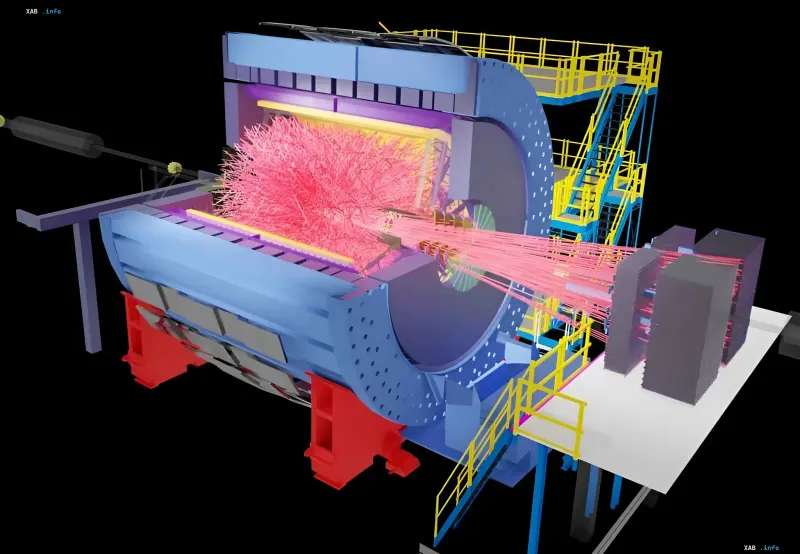
In August 2026, fundamental physics took a step that could overturn our understanding of the structure of matter. Physicists from the STAR collaboration, working at the Relativistic Heavy Ion Collider (RHIC) at Brookhaven National Laboratory, presented convincing experimental evidence for the existence of the so-called «baryon junction». This discovery confirms that quarks inside a proton are held together not just by an abstract interaction, but by a complex topological structure of the gluon field.
From Three Quarks to Complex Topology
For a long time, textbooks described the proton as a relatively simple system of three quarks bound by the strong interaction. However, an alternative theoretical model existed, suggesting that quarks are not connected directly, but through a special configuration of the gluon field — the baryon junction. In this model, the properties of the proton are determined not only by the particles themselves but also by the structure of the «glue» that binds them. Until recently, this remained only a mathematical hypothesis without direct experimental confirmation. The new work by the STAR collaboration allowed for the first time to visualize the traces of this structure in particle collision data.
Experiment at the Speed Limit
To test the hypothesis, scientists used the unique RHIC facility in Upton (New York state). This collider, consisting of two ring-shaped vacuum channels with a total length of about 4 kilometers, is capable of accelerating heavy ions to speeds close to the speed of light. The STAR detector, one of the most complex instruments in the world, was tuned to study collisions of photons with gold nuclei, as well as peripheral and head-on collisions of heavy ions. It was in these extreme conditions, mimicking the state of the Universe in the first moments after the Big Bang, that anomalies in the behavior of the baryon number appeared.
Baryon Number: The Key to the Asymmetry of the Universe
The central element of the study was the analysis of the baryon number — a fundamental quantum number that distinguishes matter from antimatter. In the traditional model, the baryon number is rigidly tied to three quarks. However, experiments showed that during particle decay, the baryon number is transferred differently than electric charge. It «travels» further and more easily than the simple quark model predicted. This observation became a decisive argument in favor of the fact that the carrier of the baryon number is precisely the gluon field of the baryon junction, and not the quarks themselves.
Why Do We Exist?
The significance of this discovery goes far beyond particle physics. It is directly related to one of the main mysteries of cosmology: why the observable Universe consists almost entirely of matter, although in the early Universe matter and antimatter should have arisen in equal amounts. Understanding the nature of the baryon junction and how it stores and transfers the baryon number gives physicists new tools to explain this imbalance. Although the new work does not provide a final answer to the question of the origin of the predominance of matter, it provides experimental support for theories that have existed for several decades.