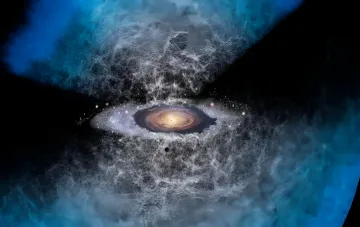
A study by Chinese astrophysicists has been published in the scientific journal Physical Review Letters, reporting the detection of a gamma-ray signal that, according to the authors, may become the first direct evidence of the existence of dark matter — the invisible component of the Universe accounting for about 85% of its total mass. The signal was identified during the analysis of a 15.5-year dataset collected by a gamma-ray telescope, and, according to the researchers, its spectral profile precisely matches the predictions of the leading weakly interacting massive particle (WIMP) model. If the interpretation is confirmed, this will be a turning point in particle physics and cosmology, since dark matter has for decades remained the subject only of indirect gravitational inferences.
The invisible mass of the Universe: what is known about dark matter
Dark matter does not emit, absorb, or reflect electromagnetic radiation in any range, which makes it fundamentally invisible to telescopes operating in the optical, radio, or X-ray spectrum. The only way to detect its presence remains gravitational effects: the anomalously high rotation speed of stars at the peripheries of galaxies, gravitational lensing of light, and the dynamics of galaxy clusters. None of these methods allows one to "see" a dark matter particle directly. This is precisely why any direct or semi-direct evidence of its existence is regarded by the scientific community as an event of exceptional importance.
The gamma-ray signal and the WIMP theory: how a particle reveals itself
The leading hypothesis in modern cosmology assumes that dark matter consists of weakly interacting massive particles — WIMPs. These particles react almost neither to electromagnetic nor to strong nuclear interactions, so they cannot be detected through ordinary light or collisions with atomic nuclei. However, the theory predicts that when two WIMP particles collide with each other, they annihilate, releasing secondary radiation, including gamma-ray quanta of a specific energy. It is exactly this "fingerprint" — a sharp spectral spike on a characteristic line — that the Chinese researchers recorded in the gamma-ray telescope data. The authors emphasize that the calculated signal-to-noise ratio exceeds by orders of magnitude the threshold at which the result could be explained by instrumental error.
Contradictory data
The primary materials cited by Ukrainian and Russian media outlets (RBC-Ukraine, Novosti, Rambler, Pravda.ru) contain a significant inconsistency in the naming of the instrument. In the text of the study quoted by the sources, the telescope is designated as "Fermi (FGST)". Yet Fermi (the Gamma-ray Space Telescope, launched by NASA in 2008) and FGST (the Chinese gamma-ray telescope) are two fundamentally different spacecraft. If the data were indeed obtained with Fermi, then a 15.5-year dataset by 2026 is quite realistic; if, however, the instrument in question is FGST, the chronology and the volume of the data require separate verification. In none of the four checked sources is it possible to unambiguously determine which exact instrument was used. Moreover, the scientific community reminds us that similar "compelling" gamma-ray signals were previously recorded in the center of the Milky Way and in a number of galaxy clusters, but their interpretation as a consequence of dark matter annihilation subsequently failed to receive consensus confirmation. The authors of the new study are aware of this and note that their signal was detected in several independent clusters, which reduces the likelihood of a local anomaly; however, the final verdict will be rendered only after repeated observations.
Outlook: doubling the data by 2040 and new telescopes
The space gamma-ray telescope continues to operate, and, according to operator estimates, by 2040 the volume of accumulated data will increase by roughly a factor of two, which will allow the statistical significance of the detected signal to be improved and its spectral profile refined. In addition, in the coming years several international space agencies plan to launch new-generation gamma-ray observatories with higher angular and energy resolution. It is precisely these instruments that will be able to definitively confirm or refute whether the recorded gamma-ray burst is humanity's first real "contact" with dark matter. Until then, the scientific community maintains a stance of cautious optimism: publication in Physical Review Letters means that the work has undergone rigorous peer review, however, the status of "unconditional proof" in particle physics is established only after independent reproduction of the result by other groups.