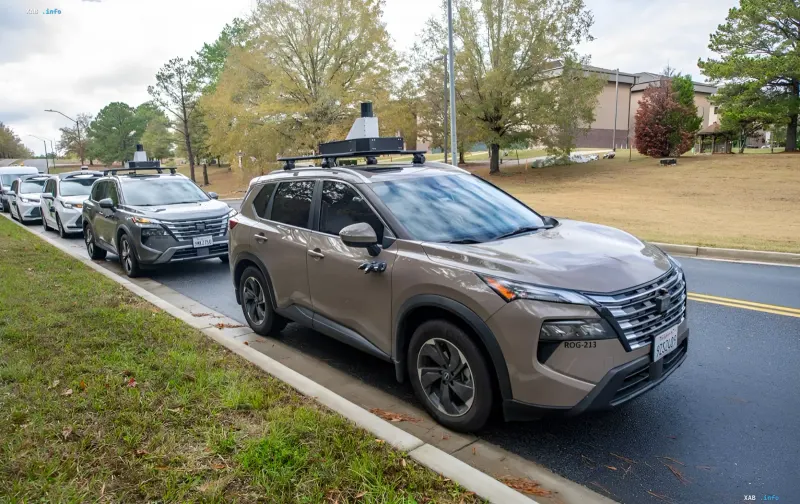
The U.S. Army has begun implementing commercial autonomous vehicles to organize internal logistics at military installations. The pilot initiative is being implemented in conjunction with the Defense Innovation Unit (DIU) and is aimed at evaluating the suitability of civilian autonomous driving technologies for military base tasks. The experiment involves a mixed fleet of six vehicles — four electric and two hybrid — supplied by three commercial companies: Applied Intuition, Forterra/May Mobility, and Perrone Robotics. According to some sources, five of the six vehicles may participate in the active testing phase.
Strategic Logic: Returning Training Hours to Soldiers
A key argument for the project is the operational burden on personnel. As Charles Auer, chief of future operations for the Directorate of Plans, Training, Mobilization, and Security at Fort Moore (formerly Fort Benning, DPTMS), explained, thousands of trainees, permanent staff, and soldiers of tenant units move across the vast training ranges, housing areas, and support facilities of the base every day. Maintaining this flow requires continuous transport dispatching and dedicated drivers — administrative and logistical functions that, according to Auer, distract military personnel from their primary tactical and training responsibilities. Integrating commercial autonomous shuttles into daily administrative routes is intended to reduce the need for soldier-drivers and reclaim this time for combat training.
Mapping Phase: Hands on the Wheel for Now
The initial phase of the project — mapping — is expected to last from two to three weeks. During this stage, all vehicles are manually operated by human drivers, while supplier teams collect data, video, and GPS coordinates to build the system's navigational architecture. Throughout the testing period, the vehicles will move strictly along pre-approved routes and only on paved roads. After mapping is completed, vendors will transition to staged demonstrations and test runs, scheduled through the end of 2026.
Fleet Composition and the Role of DIU
Selecting three different commercial vendors allows the Pentagon to compare approaches to autonomous driving in the real-world conditions of military infrastructure. The Defense Innovation Unit (DIU) acts as a coordinator, assessing how mature civilian technologies meet the safety and reliability requirements imposed on Armed Forces facilities. This format — "commercial technology + military environment" — has already become a standard model for the DIU, which has previously tested drones, satellite services, and cyber tools.
Context: Autonomous Transport in the Defense Sector
The initiative at Fort Moore fits into a broader trend of integrating autonomous systems into military logistics. In parallel, automotive companies are showcasing their own developments for the defense segment: notably, the Renault Group previously unveiled the Forefront Concept, a modular unmanned complex built on proven series automotive technologies and components. These projects collectively indicate that by the end of 2026, autonomous transport could become a standard element of the internal infrastructure of major U.S. military bases.