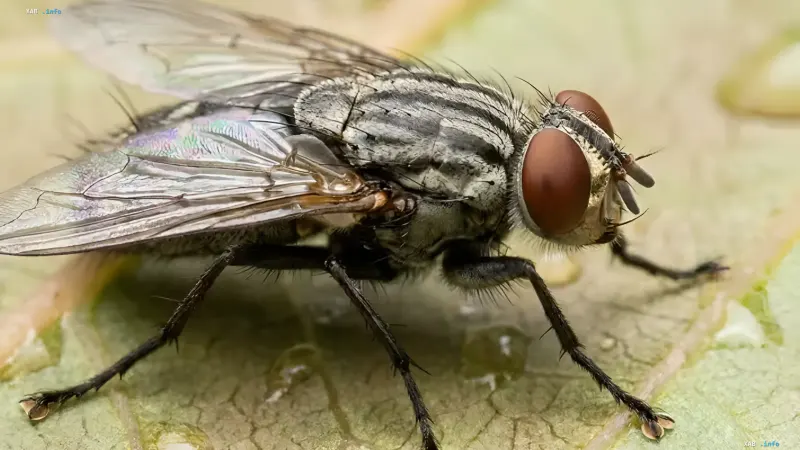
Researchers at Rice University in Houston (USA) demonstrated a method for remotely controlling the behavior of fruit flies — Drosophila — by precisely targeting their brains. According to the study, published in the journal Nature Materials, when commands were sent to specific neurons, the insects performed the required movement within about one second. The work is positioned as a significant step in the field of neurotechnology and, according to the authors, brings the creation of wireless brain–computer interfaces closer to reality.
How the Brain's "Magnetic Remote" Works
In the experiment, scientists implanted iron oxide nanoparticles into the flies' brains, which heat up under the influence of a magnetic field. At the same time, the insects were genetically modified so that their neurons contained an ion channel sensitive to the rate of temperature change. As the flies moved and crawled inside the chamber, the magnetic field changed, the implanted nanoparticles heated up, and thereby activated the necessary neurons. Thus, the physical effect of the magnetic field was converted into a controlled neural signal without any physical contact with the insect.
The Experiment: Chamber, Electromagnet, and Video Camera
The study was conducted in a specially equipped chamber: an electromagnet was installed beneath it, and a video camera at the top recorded the flies' reactions to the delivered signals. It was precisely this setup that allowed the moment of the magnetic field change to be linked to a specific behavioral response of the insects and captured in time. According to the authors' assessment, this configuration makes the experiment reproducible and suitable for further tuning of stimulation parameters.
The Mating Gesture as a Marker of Success
The video camera recorded that half a second after the magnetic signal was delivered, the genetically modified flies partially spread their wings. Specialists interpret this movement as a mating signal, typically characteristic of these creatures, which serves as a clear marker that the target neural circuit was indeed activated. The study's author, Jacob Robinson, emphasized that remote control of selected neural circuits using magnetic fields is the main goal of neurotechnology, and that their work was an important step forward in the study of the brain.
Contradictory Data
The description of the results contains two different time indicators: in one place it is reported that the flies performed the required movement "in just one second," while in another — that the partial spreading of the wings occurred "half a second" after the signal was delivered. These figures may reflect the difference between the onset of the reaction (about 0.5 s) and the full completion of the programmed movement (up to 1 s), however, in public formulations they are not always presented consistently. Until extended data on the measurement methodology become available, the exact dynamics of the response should be taken with a caveat.
Prospects: From Vision Restoration to Neurointerfaces
Currently, the team is working on methods for restoring vision in people through remote stimulation of the brain. The authors hope that the technology for precise activation of individual brain regions may in the future become the basis for treating many diseases, including neurological disorders, without surgical intervention. Moreover, according to the scientists, this approach may help in creating wireless devices that provide a direct connection between the brain and a computer; for such devices to approach the accuracy of natural brain signals, the response time needs to be reduced to a few hundredths of a second.