The field of organoid intelligence has received a notable development boost: for the first time, human stem cell-derived neural tissue has demonstrated the ability to process tactile information and identify individual Braille characters. Researchers from Bristol University call the result a breakthrough, as the experiment showed the fundamental feasibility of 'living' neural networks working with sensory data previously considered the exclusive domain of electronic processors.
How the setup works: from stem cells to multi-electrode arrays
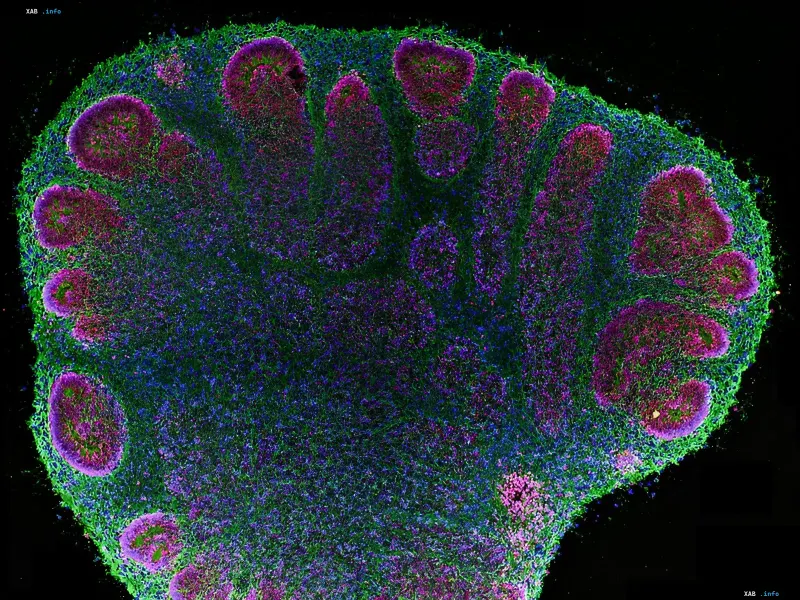
The 'computer' consisted of forebrain organoids measuring less than a millimeter each, containing roughly 10,000 neurons and supporting cells. The colonies were grown on multi-electrode arrays — devices that allow simultaneous delivery of electrical impulses and recording of neural cell activity across the entire sample area. This exact configuration made both data input and readout of the neural response possible.
Tactile sensor and encoding letters into electrical signals
Data fed into the 'brain' was generated by an Evetac tactile sensor, which scanned combinations of raised dots corresponding to the 26 letters of the Braille alphabet. The resulting information was converted into electrical impulses by encoding it into the signal's amplitude, frequency, and phase, and then fed to the organoids via the array electrodes. The resulting neural activity was recorded by the same electrodes and transmitted to a machine learning algorithm on a computer.
Letter recognition and noise immunity
A support vector machine (SVM) method was used to identify the letters, classifying characteristic patterns of neural activity. A single organoid provided a recognition accuracy of 61%, while combining data from three organoids increased it to 83%. In an additional test, the organoid-based system proved more resilient to artificial noise than an algorithm directly processing noisy input data, providing grounds to consider biological systems as a potentially more reliable data processing tool.
Why three organoids are better than one — and what the experiment lacked
Scientists are currently unable to precisely explain why the joint work of three organoids yielded a better result than a single one. One hypothesis: differences in neural connections and the activity of individual structures provide complementary information — much like three observers with individual viewpoints forming a more complete picture of an object. Importantly, the experiment was conducted without feedback on recognition correctness: the organoids received information, but no learning took place. The goal was to prove the fundamental possibility of processing initially tactile information, and the researchers achieved it.
Prospects for biohybrid computing
Moving forward, the team intends to study the processing of other tactile signals — information about textures and object boundaries — as well as the possibility of creating closed-loop systems with feedback. Biohybrid computing is viewed as a promising direction, though the practical superiority of such systems over conventional electronic processors has not yet been proven, and confirming it will be the developers' next goal.