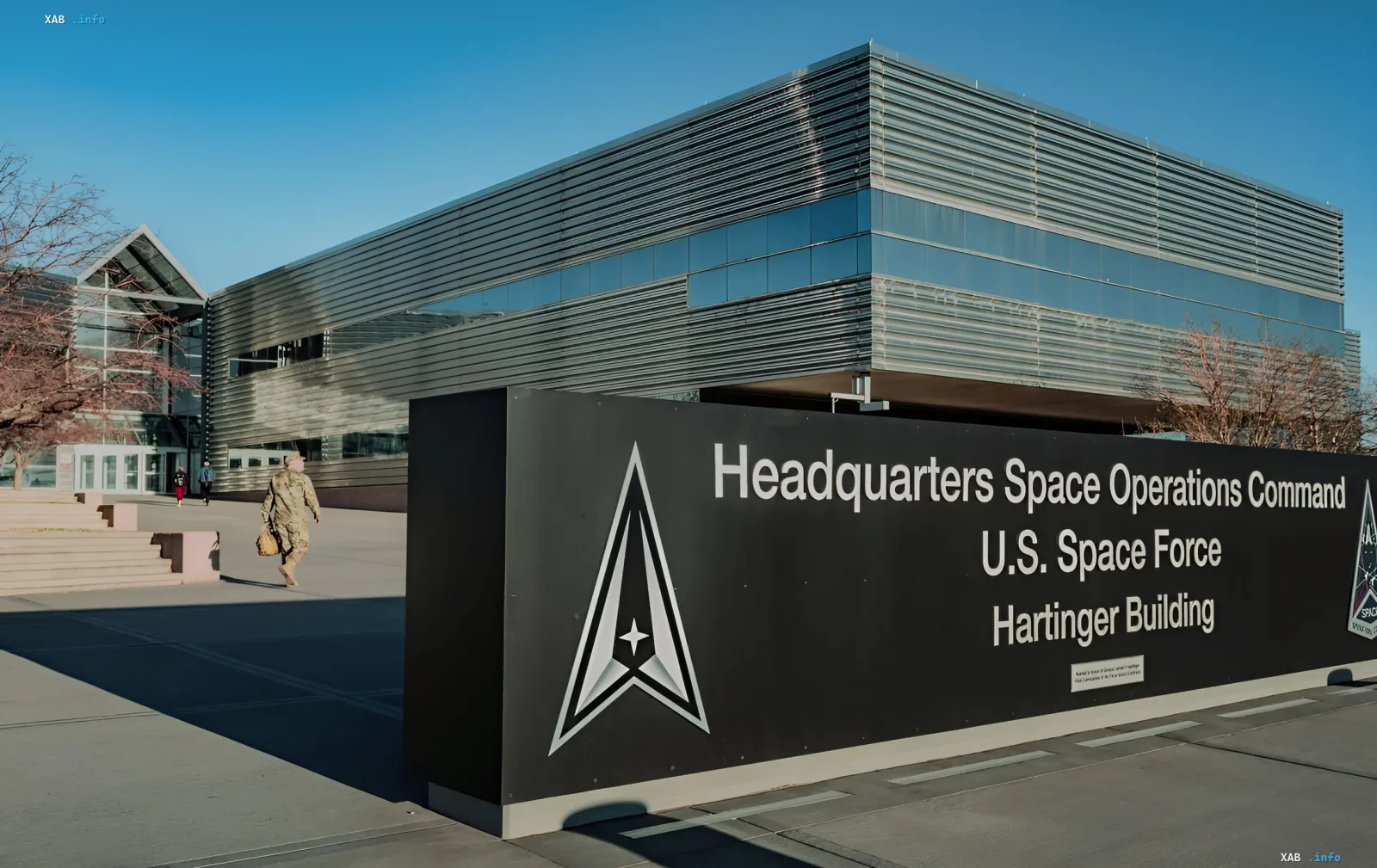
The U.S. Space Force has selected American defense company Leonardo DRS to develop a space-based sensor capable of detecting, identifying, and maintaining tracking of high-speed targets and generating engagement-ready data. This is reported by RBC-Ukraine, citing the publication Army Recognition. The photo shows the headquarters building of the U.S. Space Force (Hartinger Building), which is consistent with the institutional context of the deal.
Contract in the Form of an Other Transaction Agreement
The agreement with Leonardo DRS — a company headquartered in Arlington, Virginia — is structured as an Other Transaction Agreement (OTA). This mechanism allows emerging technologies to be advanced rapidly from prototype to testing and field deployment, bypassing some procedures of the traditional government procurement cycle. According to the source, this is one of seven similar contracts signed by the U.S. Space Force in May–June 2026; six additional deals were planned for July, which in total would bring the number of such agreements to 13, worth more than 500 million dollars in aggregate.
What Is Known About the Sensor — and What Was Not Disclosed
Leonardo DRS stated that the new sensor will support the space mission and build on the company's existing and future developments in sensor technology. Among the priorities are affordability, the ability to scale production, and a resilient supply chain. However, the company did not disclose the contract value, development timelines, orbital architecture, spectral bands, detection range, or the specific list of threats, nor did it clarify which exact targets — spacecraft, missiles, hypersonic weapons, or air systems — will fall within the sensor's area of responsibility.
From Launch Warnings to Targeting
As analysts note, the mere detection of a high-speed object provides only initial awareness of a threat. Identifying the target, maintaining precise tracking, and generating engagement-ready data turn the sensor into a link in the kill chain. A key task for the U.S. Space Force is to shorten the time between threat detection and the delivery of usable information to command-and-control networks and response systems. The new project reflects a broader shift in U.S. military space tracking: from missile launch warnings to continuous target tracking and the provision of data sufficient for engagement decisions. Similar systems are already used by the Pentagon — in particular, L3Harris's missile-tracking satellites — however, the Leonardo DRS sensor is being developed as a separate, standalone system.
The "sensor-to-shooter" process becomes more complex when the target maneuvers or moves at very high speed: if the sensor detects an object but loses tracking before another sensor or weapon system takes over the track, the operational value of the initial detection drops sharply. A space-based sensor capable of maintaining high-quality tracking reduces gaps in target reacquisition, improves tracking continuity, and gives commanders more time and confidence in decision-making.
The Italian Factor and the Link to Ukraine
Leonardo DRS is a subsidiary of the Italian defense giant Leonardo SpA, which in 2026 opened its own unit in Ukraine for research and development in defense technologies. It was reported that the company plans to test its new Michelangelo air-defense dome in combat conditions on Ukrainian territory. Thus, the contract with the U.S. Space Force strengthens the presence of the Italian defense cluster in the American space segment and simultaneously links it to the European-Ukrainian track.
Strategic Context of Threats
Tracking hypersonic targets and countering anti-space threats remain an important strategic context: both areas require high-speed detection, sustained tracking, and data processing with minimal latency. China and Russia are also developing increasingly sophisticated space weapons and anti-space systems; however, these capabilities should be viewed as a general threat backdrop rather than as a confirmed subject of this specific contract. Leonardo DRS already has experience in military space tracking, including the development of infrared payloads for tracking ballistic and hypersonic targets, which, according to experts, reduces the technological risks of the new project.