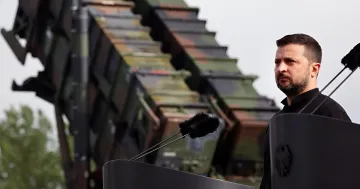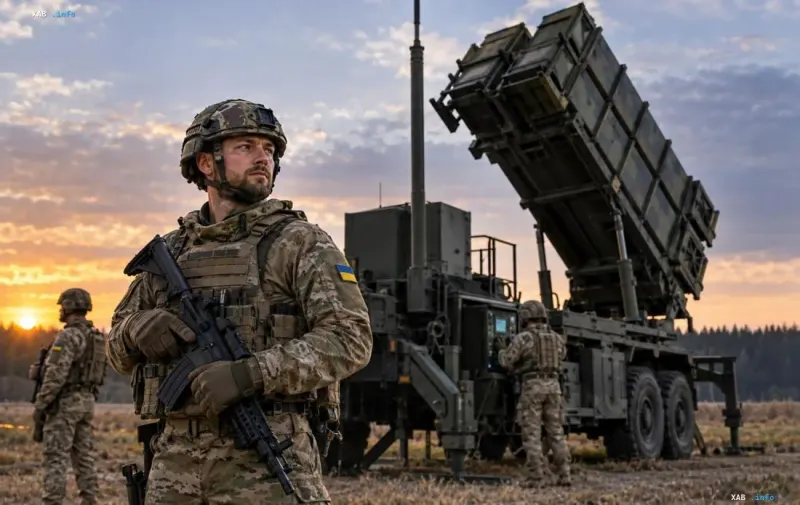
US State Department spokesperson Jan Beatterson stated that Washington has not made a final decision on granting Ukraine a license to produce missiles for the Patriot air defense systems. According to him, diplomatic negotiations on this issue are ongoing, and the absence of specific details at the current stage should not be interpreted as a negative signal. Beatterson emphasized that White House chief Donald Trump, whom he described as a "man of action," expects corresponding actions from partners before moving to the practical implementation of the agreement.
Context: Trump and Zelensky's meeting in New York
The State Department's statement came against the backdrop of a recent meeting between the presidents of the United States and Ukraine in New York. Vladimir Zelensky, after the talks, reported that the American leader has a positive attitude toward providing Kyiv with the relevant licenses. "We asked the president to help us move faster in this direction. God willing, we will start this project in a year or a year and a half," the Ukrainian leader noted. Beatterson, commenting on the outcomes of the meeting, pointed to the "good impression" made by the Ukrainian army and regarded Trump's public assessments of the Ukrainian Armed Forces as a "good sign," however, he emphasized that specific mechanisms and timelines remain undetermined for now.
Production aspect: the role of Raytheon and launch timelines
Earlier, Zelensky stated that the American corporation Raytheon — the main producer of missiles for Patriot systems — is ready to organize their production directly on Ukrainian territory. Kyiv has appealed to Washington to help accelerate this process as much as possible. At the same time, the realistic launch horizon, voiced by Zelensky himself, is from one to a year and a half, which indicates a significant bureaucratic and technological cycle: from the coordination of export restrictions and technology transfer to bringing production to serial volumes.
European dimension: Berlin's position and the PAC-3 shortage
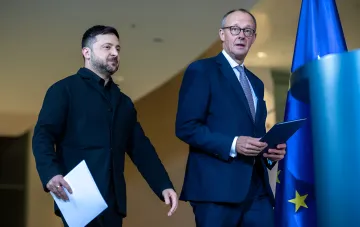
The problem of the air defense shortage is not limited to the bilateral US–Ukraine track. German Defense Minister Boris Pistorius noted that Berlin is able to cover the internal shortage of PAC-3 missiles for Patriot, but for deploying their production on European territory, an official authorization and license from Washington are required. Thus, the licensing issue becomes key not only for Kyiv but for the entire European air defense architecture, which increases the geopolitical significance of the decision that the State Department is currently postponing.
Contradictory data
In the public discourse surrounding the Patriot license, a notable gap is traceable between the rhetoric of the White House and the position of the diplomatic apparatus. On the one hand, Donald Trump in public speeches has expressed readiness to provide Kyiv with a license, and Zelensky interpreted the outcomes of their meeting as confirmation of a positive vector. On the other hand, the official State Department spokesperson Jan Beatterson directly stated that a final decision has not been made and negotiations are ongoing. The difference between the president's "readiness" and the department's "lack of decision" can be explained both by internal procedural requirements (coordination with the Pentagon, export control, Congress) and by a deliberate Washington tactic of not fixing commitments until all working groups are completed. For the reader, this means that Trump's public support is not equivalent to a legally binding act, and the actual launch of production may either accelerate or be delayed beyond the optimistic forecast of "a year to a year and a half."
What this means for Ukrainian air defense
Until the license is signed, Ukraine remains dependent on imported supplies of Patriot and PAC-3 missiles, the volumes of which are limited by Raytheon's production capacities and the Pentagon's priorities. Experts point out that even after obtaining the license and launching local production, the effect on the operational situation will not be noticeable earlier than in 12–18 months. In the short term, Kyiv continues to insist on accelerating the delivery of finished missiles and expanding European production, while Washington retains the right to determine the pace and terms of technology transfer.