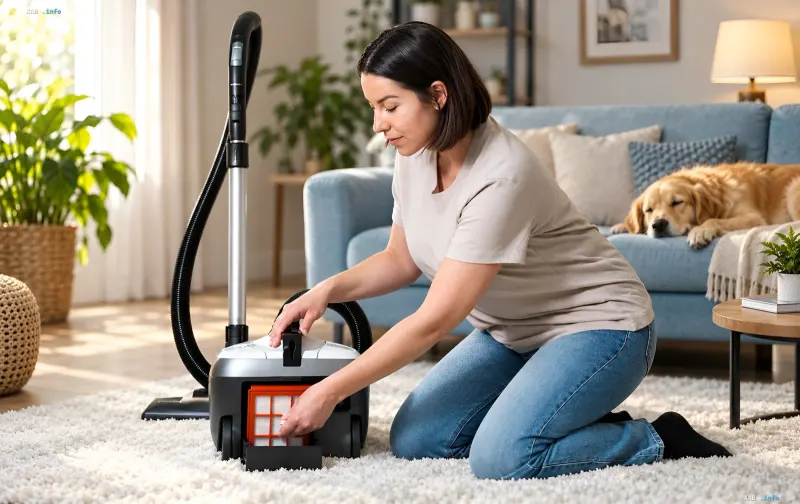
A vacuum cleaner can run, hum, and even spin its brush, yet barely pick up debris from the floor. In most cases, this is not a sign of a serious motor failure; more often, the problem lies in disrupted airflow through the device. The vacuum draws in air along with dust and small debris, and when this flow is blocked, cleaning efficiency drops sharply while the motor sound remains nearly unchanged. According to home appliance manufacturer Electrolux, common causes of weak suction include a full dust container, clogged filters, blocked air channels, and a dirty brush. Before any inspection, it is important to turn off the appliance and unplug it from the mains; for cordless models, follow the manufacturer's instructions for safe cleaning.
Overfull Dust Container and Clogged Bag
The simplest and most frequent cause of lost power is a full container. When it is overflowing, the debris obstructs normal air movement, and in bagged models, a similar problem occurs when the pores of the material become clogged with fine dust. According to specialists described in appliance repair materials, a bag is considered full when it reaches about two-thirds of its capacity, and ignoring this condition leads to further deterioration of suction and the risk of overheating. To fix the issue, simply remove the container and empty it: even if it is not completely full, check whether dust is blocking the air channel. Disposable bags are not meant to be washed or reused—they must be replaced. Before turning the device back on, make sure the container or bag is installed correctly and the lid is firmly closed.
Clogged Filters: The Invisible Culprit
Even an empty container does not guarantee normal operation if the filter is dirty. Fine dust gradually accumulates in the filtering material and restricts the airflow, causing the vacuum to clean poorly even though the engine sound remains the same. To check the filter, locate it according to your specific model's manual and inspect the surface for a thick layer of dust, damage, or deformation. If the manufacturer allows washing the filter with water, wait until it is completely dry before reinstalling: never put a damp element back in. It is important to remember that not all filters are washable—some HEPA filters and other filtering elements require dry cleaning or replacement only. Regular cleaning, according to appliance care experts, should not be limited to just emptying the container: special attention must be paid to tubes, filters, and brushes where dirt accumulates.
Blockages in the Hose, Tube, and Nozzle
If the vacuum suddenly stops picking up debris, the cause may be an object stuck inside. Most commonly, airflow is hindered by clumps of hair, paper, large pieces of garbage, or other objects accidentally sucked in by the appliance. Appliance manufacturer Kärcher recommends checking the nozzle, tube, handle, and hose for blockages whenever suction power drops. To find the problem, disconnect the hose from the body and inspect it from both ends; if the design allows, check the tube and nozzle separately. Debris visible near the edge can be carefully removed by hand or with a suitable blunt tool. At the same time, do not force the blockage or use sharp metal objects that could damage the hose.
Brush Roll and Carpet Cleaning
Sometimes a vacuum maintains normal suction power but struggles to pick up debris specifically from carpets. The cause may be the brush roll, wrapped with hair, pet fur, or threads: if the brush stops spinning, cleaning efficiency on fibrous surfaces drops. Electrolux recommends checking the nozzle and brush roll for blockages and using the correct nozzle for the specific floor covering. To clean the brush, remove the nozzle if the design permits, check for hair or threads around the roll, carefully remove the tangled debris, and make sure the brush is not blocked before reassembling the unit. If the roll still does not spin after cleaning, the drive mechanism may be faulty—in this case, you should contact a service center.
Air Leaks and Overheating: When You Need a Professional
If air enters through a gap in the housing, a damaged hose, or a worn seal, the suction power at the nozzle decreases. Kärcher lists seal replacement among the ways to fix this issue: check if the dust compartment lid closes tightly, if the container is installed correctly, and if there are visible cracks in the hose. If the seal is deformed or torn, it is better to replace it with a compatible part rather than trying to patch the damage. Overheating deserves special attention: if the device not only has weak suction but also shuts down suddenly, the cause may be overheating due to a blockage. Electrolux guidelines note that a blocked brush, nozzle, or hose can lead to such a situation. It is in these cases—brush drive failure, unfixable leaks, and recurring overheating—that DIY repair is no longer practical, and the appliance should be taken to a service center.