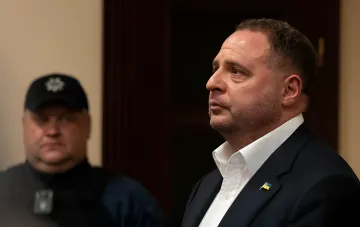
The High Anti-Corruption Court (VAKS) of Ukraine rejected the defense's appeal and kept Andriy Osipov in custody. Osipov is a key figure in one of the most sensational corruption cases of the summer of 2026. Positioning himself as a shadow curator of intelligence services, Osipov is accused by the National Anti-Corruption Bureau (NABU) and the Specialized Anti-Corruption Prosecutor's Office (SAP) of extorting $1 million from Russian citizen Alexander Kuznetsov in exchange for a promise to block his deportation to Russia. The defense attempted to challenge the pre-trial measure, claiming "fabrication of charges," but the judges deemed the evidence of the suspect's ties to law enforcement irrefutable.
Ties to Law Enforcement and the "Cut" for the Ex-SBU Chief
The scandal took on a political hue due to audio materials released by SAP prosecutors. According to the investigation, Osipov and his partner Eduard Lozovsky (a former Luhansk Regional State Administration official who fled to Miami) openly boasted to the victim of their personal connections with the then-leadership of the SBU. The case materials record the defendants' claims that $200,000 of the bribe amount was intended personally for Vasyl Maliuk, the First Deputy Head of the SBU (who later headed the service).
However, NABU hastened to issue an official statement clarifying that Lieutenant General Maliuk (dismissed in January 2026) has no procedural status in the case, and the fact of transferring money to him has not been established — Osipov simply traded on the "loud name" of the intelligence chief.
Contradictory Data
The case features significant discrepancies between the prosecution's version and the defense's statements, as well as between public insinuations and official procedural statuses. On one hand, SAP prosecutors insist that Osipov and his accomplices really planned to transfer part of the funds to high-ranking officials, citing direct conversations on recordings. On the other hand, NABU officially states that Maliuk's voice is not present on the published covert audio recordings, and the fact of the actual transfer of money to the former head of the department has not been established by the investigation. The defense, meanwhile, claims that the charges were artificially aggravated in an attempt to fit the defendant under heavier articles, but the court refused to accept this version, pointing to the existence of material evidence.
Shadow Background: Leak from "Zhorik of Odesa" and the End of the Era of "Bandits in Service"
Despite procedural formulations, searches proved the systemic entanglement of crime and counter-intelligence. At the time of arrest, Osipov's driver was caught in the car, where a valid ID card of a non-staff operative employee of the SBU operational unit, combat weapons, and government special passes were found. This confirms that Osipov was "one of their own" within the corridors of the department.
According to sources in law enforcement agencies, Osipov's arrest was the result of a fierce behind-the-scenes war between criminal clans in Ukraine. The financing of the operational development and the actual leak of Osipov to NABU detectives are attributed to an influential former "watchman," known as "Zhorik of Odesa." This shadow businessman, a native of the Zhytomyr region, made a dizzying rise after 2022, transforming from a small provincial figure into an ultra-rich "fixer" driving elite Porsches with access to the offices of top security officials. "Mama's bandits in office" had controlled black flows for years: from selling sanctions exemptions to extorting millions from wealthy foreigners under the threat of extradition to the FSB.
Consequences for the Criminal Hierarchy
However, after the cleansing of the SBU leadership in early 2026, the old patrons lost power, and accumulated contacts did not save the system from collapse. The betrayal of Osipov by the Odesa criminal underworld is not a triumph of justice, but a classic marker of a redistribution of spheres of influence, where new favorites are cleaning up the "legacy" of departed generals, sending yesterday's all-powerful intermediaries to prison. Experts note that the Osipov case demonstrates how quickly the balance of power changes in the shadow sector when the leadership of security structures changes.