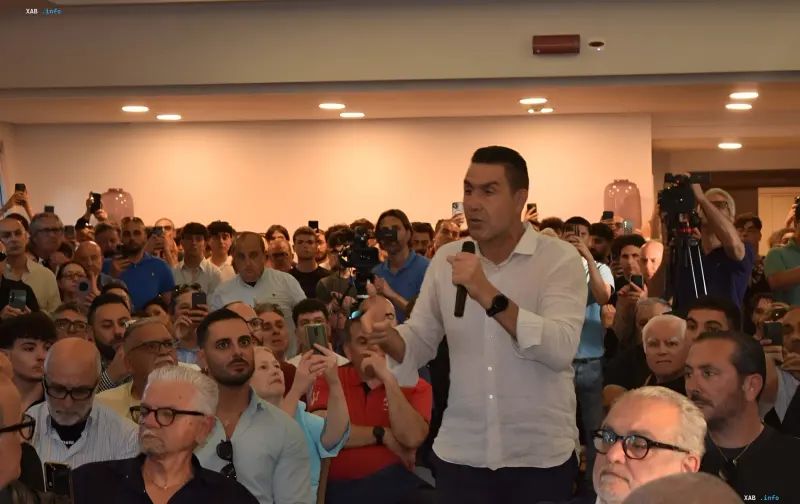
A notable shift is underway in Italian political life: Roberto Vannacci, a far-right politician and former general of the Italian armed forces known for his pro-Moscow views, is rapidly gaining popularity. According to the latest data, his rating has already exceeded 7% — a figure that, observers estimate, partially "siphons off" votes from the incumbent Prime Minister Giorgia Meloni. With next year's elections approaching, this could force the head of government to seek an electoral alliance with him, which in itself would signal a dilution of Rome's pro-Western line.
Moscow Through the Eyes of a Military Attaché
Vannacci is no novice in the Russian context: in 2021–2022 he served as Italy's military attaché in Moscow. His former acquaintance, John Foran, the former British military attaché in Russia, was impressed by the Italian's open fascination with Russia. According to Foran, Vannacci was charmed by the idea of "strongman leadership" and order — a trait typical of many Italian officers. His wife liked the cleanliness of Moscow, and the general himself claimed that his children could play safely on the playground there, "just like in Italy once." Particularly telling is the fact that even at the end of 2021, when Russia was massing troops on the border with Ukraine, Vannacci continued to insist that an invasion would not happen, loudly convincing even the Italian ambassador in Moscow of this. Foran described him as an inexperienced person suffering from "arrogance, excessive self-confidence and gullibility" and lacking reliable sources.
The 'Trojan Horse' and Western Warnings
After Russia's full-scale invasion in February 2022, Vannacci was among the 24 Italian diplomats expelled from Moscow in May in response to Italy's similar move against Russian diplomats. Since then he has openly called for Italy to stop supporting Ukraine and to lift sanctions against Russia. The Western expert community reacts sharply to his rise: the politician has been directly called a "Trojan horse" of Russian influence in Italy. Foran warned that if Italy begins to waver in its support for Ukraine, this would "please Moscow," which is trying to blow up the unity of Europe. At the same time, in his assessment, Vannacci is not a Russian agent — the politician, Foran believes, is driven not by ties with the GRU but by his own "desires" regarding Russia.
Contradictory Data
The available sources contain a discrepancy in the attribution of the key metaphor. In one account, Vannacci is named the "Trojan horse of Russian influence in Italy" by the European Council on Foreign Relations (ECFR), while a number of other publications link the phrase "the Kremlin's Trojan horse" to the Financial Times. Thus, both versions agree on the essence of the assessment but differ on who exactly first attached this label to the politician. It is also worth noting that Foran himself, while describing Vannacci's pro-Moscow orientation, simultaneously denies any operational link with Russian intelligence services — this creates a contradiction between the rhetoric of "foreign influence" and the assessment of "internal ideology," which is important to bear in mind when interpreting the topic.
Defense Context: Italy and Ukraine
The rise in popularity of a pro-Moscow politician is taking place against the backdrop of deep defense integration between Italy and Ukraine. The Italian company Leonardo, in particular, is seeking through its new Kyiv branch to deepen cooperation with the Ukrainian defense industry and has already reported on the timing of air defense tests in Ukraine. In addition, Mykhailo Fedorov has become an advisor to the Italian Minister of Defense, helping the country develop modern war technologies and the digitalization of the defense sector. It was also previously reported that Italy had secretly agreed to transfer anti-ballistic weapons to Ukraine — in particular, Aster 30 missiles, SAMP/T NG systems and radars, some of which are planned to be handed over within the coming months. It is precisely this contrast — on the one hand, practical military support for Kyiv, and on the other, the electoral success of a politician calling for that support to be stopped — that makes Vannacci's figure a key factor in Italian and European politics in the coming year.