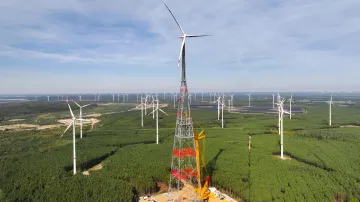
The Supreme Court of Ukraine is hearing one of the largest insurance disputes in the country's history: the owners of wind power plants in Kherson Oblast — the companies Windkraft Tavria and Windkraft Kalanchak — are seeking compensation from the Austrian insurance company UNIQA (part of the UNIQA Insurance Group group) exceeding 10 billion UAH. The reason for the lawsuit is the loss of assets as a result of the Russian occupation of the territory. According to the court registry, in one of the claims the court of first instance already ordered the insurer to pay more than 2.5 billion UAH, however the appellate court overturned this decision, and the case was returned for review by the supreme judicial body. At stake is not only the financial interest of private investors, but also the positions of state banks, in whose collateral the lost energy facilities are pledged.
The Mechanics of the Dispute: From First Instance to the Supreme Court
Insurance contracts for property against war risks were concluded between Windkraft Tavria, Windkraft Kalanchak and the Ukrainian branch of UNIQA. After the wind power plants in Kherson Oblast came under occupation, the policyholders turned to the insurer with a claim for payment. The court of first instance sided with Windkraft Tavria, ordering UNIQA to pay over 2.5 billion UAH. The appellate court, however, overturned this decision, which forced the plaintiffs to seek justice in the Supreme Court. At present, both disputes are at the stage of review by the highest judicial instance, and the final ruling may become a precedent for the entire war-risk insurance market in Ukraine.
The Diplomatic Dimension: Why the Case Is Being Watched in Vienna and Stockholm
Particular attention to the case has been drawn by the active involvement of Austrian diplomacy. In 2025, the Austrian Embassy in Ukraine sent a note to the court requesting permission for a representative of the diplomatic mission to attend the hearings as an observer. The embassy explained this step by the "significance of the proceedings for Ukraine's investment attractiveness." Additional resonance was gained by the personal meeting between Austrian Ambassador Robert Müller and the head of the Supreme Court, Stanislav Kравченко, which observers also link to the insurance conflict. The international dimension of the case is further strengthened by the fact that the owners of Windkraft are Swedish citizens — Carl Olof Richard Sturen and Johan Sven Richard Bodén. The State Secretary of the Swedish Ministry of Foreign Affairs, Eva Svedling, was present at the opening ceremony of the Novotroitska WPP in 2017, which underscores the strategic significance of the project for Swedish-Ukrainian cooperation in the energy sector.
Contradictory Data
A number of contradictory versions have formed around the case, which have not yet received official confirmation. On the one hand, according to a publication, in the recordings of conversations of the former Deputy Head of the Office of the President, Iryna Mudra, recorded by the NABU as part of the "Themis" operation investigating corruption in the judicial system, there are mentions of contacts with the Austrian ambassador. On the other hand, anti-corruption authorities have to date not provided official confirmation of this data, and the link between the recordings and the current insurance dispute remains a matter of speculation. At the same time, Windkraft, at one stage of the proceedings, requested the recusal of a judge, viewing the actions of the Austrian diplomatic mission as possible pressure on the judicial process. According to the court registry, the request to replace the judge was denied. The Austrian side, conversely, insists that its involvement is driven solely by interest in the investment climate. Thus, one side sees in the diplomatic activity an attempt to influence the verdict, while the other sees legitimate observation of a process on which the trust of foreign investors in the Ukrainian judicial system depends.
Procedural Twists and the Question of Recusal
The course of the proceedings was not without procedural conflicts within the Supreme Court itself. Judge Oleg Sluch declared his own recusal from the panel, justifying the decision by friendly relations with the representative of UNIQA. This episode further intensified public attention to the case and questions about the independence of the review. For Windkraft, such situations only reinforce the argument for the need for an impartial hearing without external pressure — neither from the insurer nor from diplomatic missions.
Impact on State Creditors and Macroeconomic Risks
The lost wind power plants are pledged to Ukrainian banks, including the state-owned Oschadbank. This means that the outcome of the insurance dispute directly affects the interests of the state creditor: in the event of a favorable verdict for Windkraft, the insurance compensation will go toward repaying the collateral obligations, while in the event of a loss — the risks will be redistributed to the banking sector. Notably, the judges refused the state banks' request to join the case as third parties, which deprives them of direct procedural influence on the outcome. Some analysts warn that a protracted judicial conflict involving an Austrian insurer and Swedish owners could affect bilateral relations between Ukraine and Sweden and Austria — a scenario that, in the context of the ongoing Russian invasion, is considered highly undesirable for Kyiv.