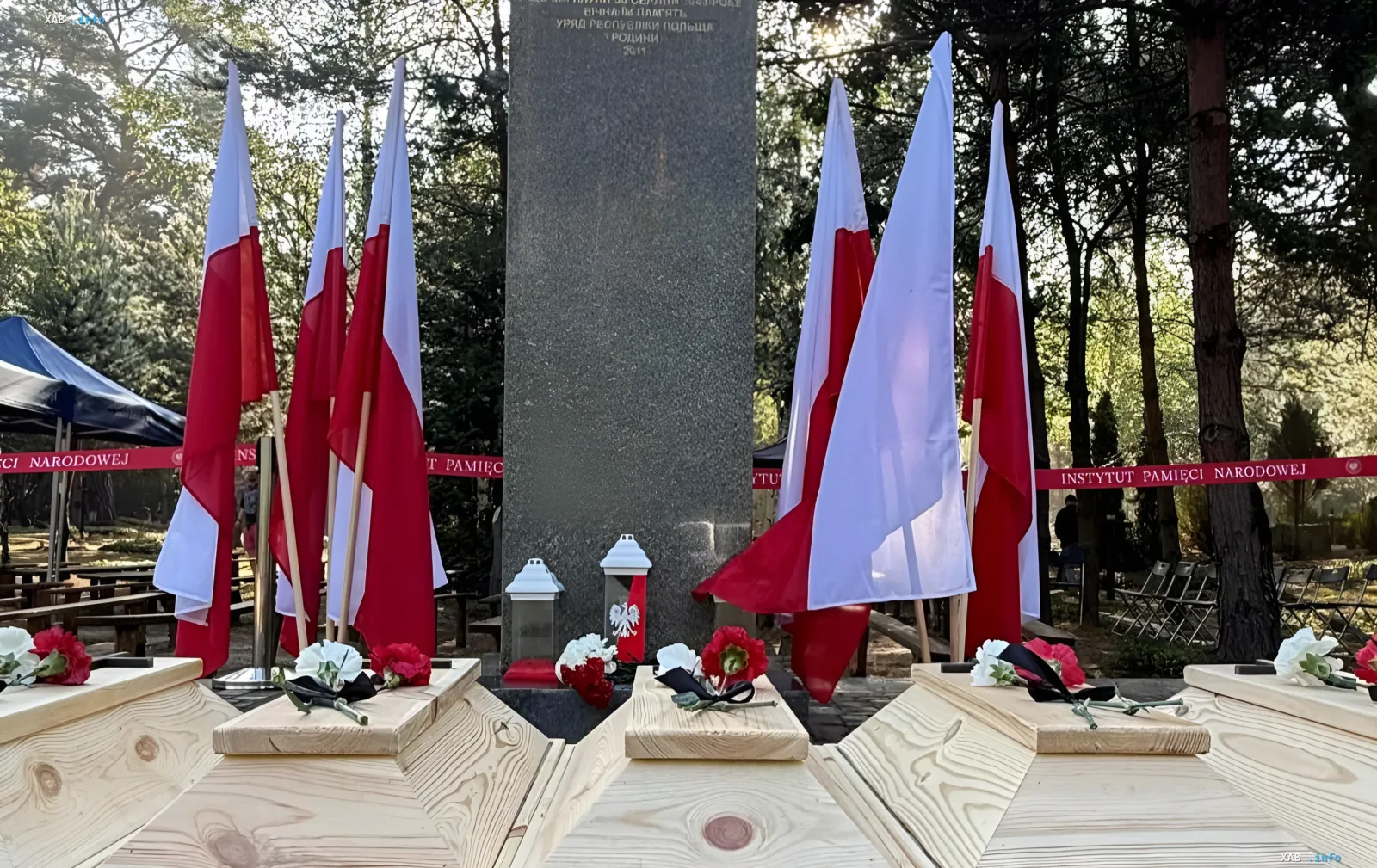
On August 30, 2026, a ceremony was held at the cemetery of the former village of Ostrovki in Ukraine's Volhynia region to reinter the remains of 55 Polish victims of the 1943 Volhynia tragedy. The solemn event was timed to coincide with the anniversary of the attacks on the settlements of Ostrovki and Wola Ostrowiecka, as a result of which, according to Polish historians, the majority of the residents of both villages were killed and the settlements themselves were burned down. The ceremony was attended by representatives of the Polish Institute of National Remembrance (IPN), whose flags and banners bearing the inscription "Instytut Pamięci Narodowej" decorated the venue. Photographs from the ceremony show Polish national flags, wreaths of red and white roses, memorial candles, and a wooden coffin placed at the foot of a granite monument bearing an inscription in Ukrainian.
Exhumation results: 48 people in a mass grave, 26 children among the victims
The remains of 55 people were discovered during exhumation work that concluded in early August 2026 on the territory of the former villages of Ostrovki and Wola Ostrowiecka. According to Polish specialists, 48 victims were found in a mass grave on the territory of a former farmstead in Wola Ostrowiecka, six more were found near the former school in Ostrovki, and the remains of one woman were found in a separate grave in the forest. The particular tragedy of the scale of the events is underscored by the fact that among those reinterred are 26 children. Ukrainian and Polish specialists jointly carried out the search and exhumation work, marking a continuation of the long-standing cooperation between the two countries in the field of historical memory.
A long history of searches: from 1992 to the present
The 2026 reinterment became the latest stage in a long chain of exhumations that began back in 1992. Previously, the remains of victims of the Volhynia tragedy were discovered and reinterred during work carried out in 1992, 2011, and 2015. The deceased were buried next to the graves of victims found in previous years, forming a single memorial space at the cemetery of the former village of Ostrovki. Polish historians note that the remains of approximately 300 more people may still remain in Ostrovki and Wola Ostrowiecka, indicating the need to continue search work in the future. Poland had previously handed Ukraine a list of new sites for search and exhumation work, demonstrating that the issue remains relevant at the interstate level.
Diplomatic context and significance of the ceremony
The reinterment ceremony, organized with the participation of the Polish Institute of National Remembrance, carries not only memorial but also diplomatic significance. The joint exhumation work by Ukrainian and Polish specialists demonstrates practical cooperation between the two countries in preserving historical memory. Poland's transfer of a list of new search sites to Ukraine confirms that the process of identifying and reintering the victims of the 1943 Volhynia tragedy remains an active area of bilateral relations. The granite monument at the reinterment site, with an inscription indicating the participation of the Government of the Republic of Poland and the families of the victims (2011), serves as a permanent reminder of the tragedy and the obligations owed to the memory of the victims.