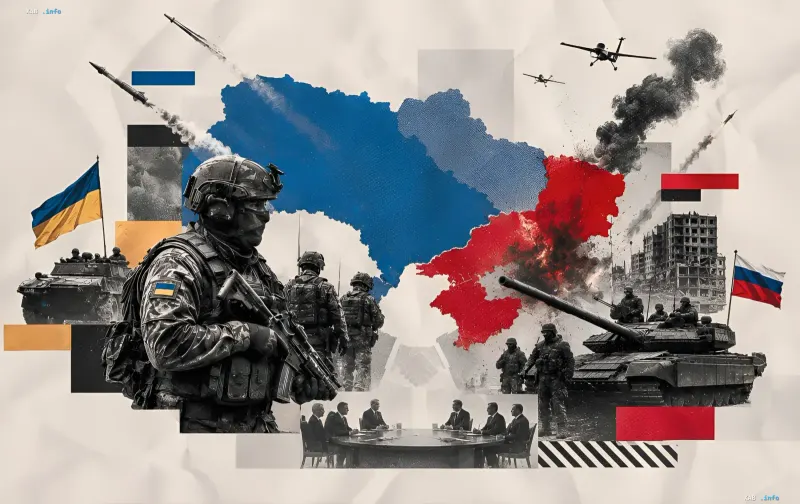
The war in Ukraine is entering the second half of the year. Against the backdrop of a lack of victorious breakthroughs by Russia and Moscow's unwillingness to stop hostilities, Ukraine is forced to shift the focus to containing pressure and expanding attacks into the Russian rear. Expectations of a quick end to the conflict are increasingly diverging from the reality on the front lines.
Tactical shift: from offense to containment
Unlike previous years, when the pace of the enemy's advance peaked in the second half of spring and summer, this year Russia's activity is significantly lower. The offensive in the Zaporizhzhia region, which Moscow tried to intensify, has stalled under the influence of Ukrainian counterattacks. However, this does not mean abandoning the direction: even limited activity there forces Kyiv to hold forces that could otherwise be redeployed to the Donbas.
Main theater: Donetsk region
The main focus of hostilities has shifted to the Donetsk region. The enemy's current goal is to capture the Kramatorsk-Konstantynivka agglomeration, which is the foundation of Ukraine's defense in the northern part of the region. The Russians are trying to get closer to Sloviansk and Kramatorsk, key fortresses under Ukrainian control.
The most threatening situation has developed in Konstantynivka. According to sources, enemy troops are already being detected in most of the city, trying to cut it off from roads and logistics. To the south, the "Center" grouping of troops is trying to break through to Dobropillia to bypass Konstantynivka, Druzhkivka, and Kramatorsk from the west. Another dangerous sector is the Lyman area, where the occupiers are trying to push through from the east.
Expert forecasts: risks of losing territory
RBC-Ukraine's interlocutors in military-political circles do not see preconditions for a rapid operational breakthrough of the entire Ukrainian defensive line in the Donetsk region. However, they allow that in the coming months, Ukraine may lose control over Konstantynivka. A similar risk, according to their assessment, could hang over Lyman and Dobropillia by the end of the year.
In the event of an unfavorable development, Russian troops could get very close to Sloviansk and Kramatorsk by the end of winter. However, to do this, Russia will have to sequentially overcome prepared defensive lines, expand its flanks, and pull up logistics, while constantly being under attack by Ukrainian drones.
Threat from the north and personnel shortage
A possible new Russian operation from the North remains in question. Sources lean towards the idea that the enemy may conduct an operation with limited forces, attempting to breach the border in the Chernihiv or Kyiv region. The Bryansk region could serve as a bridgehead for offensive actions in this case. The direct participation of Belarus is not currently considered mandatory.
Even in such a scenario, the goal of a possible offensive in the North is unlikely to be a deep breakthrough to Kyiv. Russia may officially call this an "attempt" to create a so-called buffer zone along the border. But this is more likely a tool of a broader scheme — to stretch the Ukrainian defense along the border and force Kyiv to withdraw forces from where Russia is trying to achieve the main result — in the Donetsk region.
The success of such operations will depend on the Kremlin's mobilization decisions. The enemy's army is already experiencing a shortage of personnel. Although the plan for recruiting contractors is being fulfilled almost 100%, this is insufficient not only for forming new units but also for fully replenishing losses.