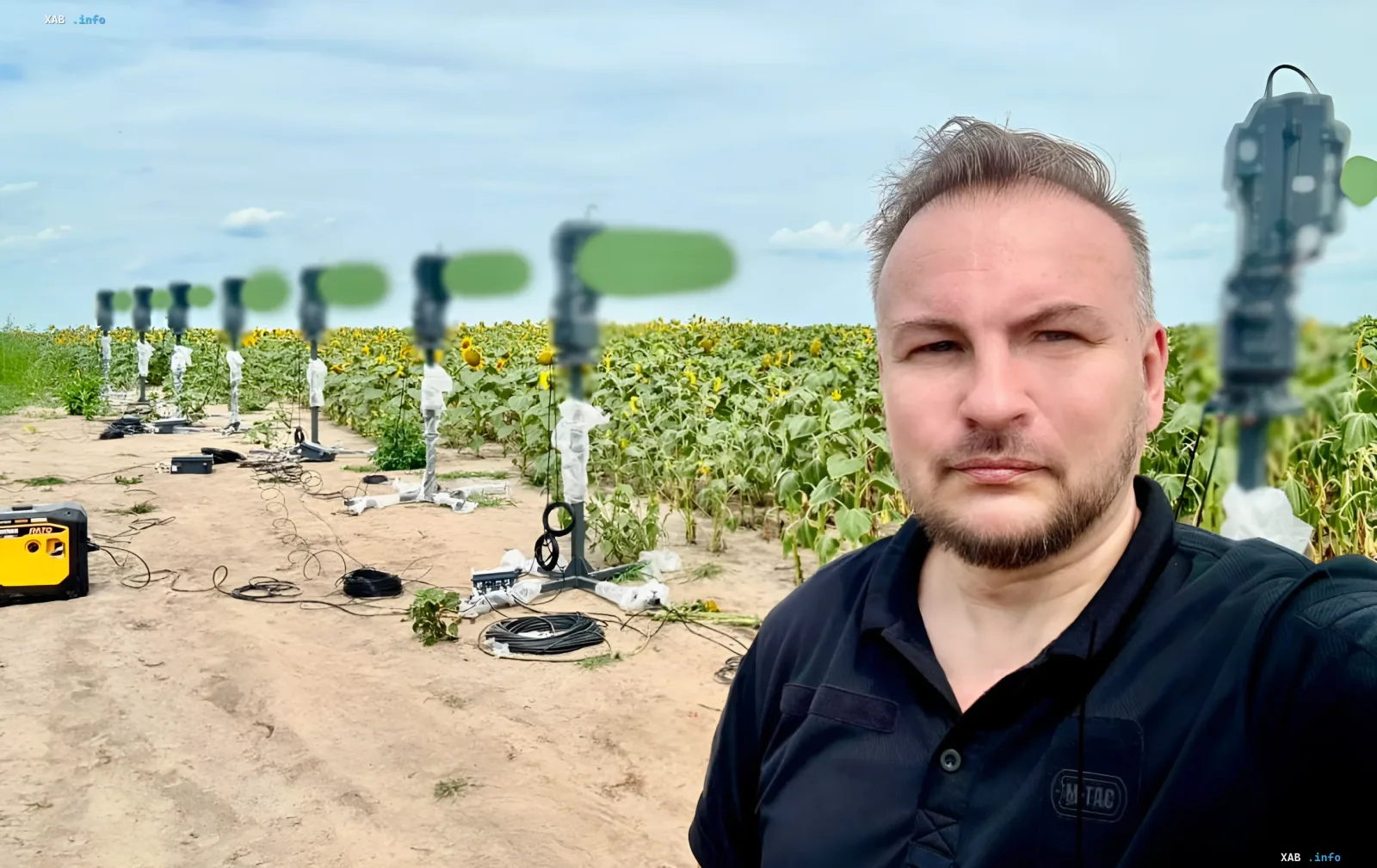
On one of the Ukrainian test ranges, a complex system of technical equipment has been deployed. Against the backdrop of sunflower fields, a line of equipment connected to generators and cables is set up. This is not just a technical trial, but a response to a specific threat facing the country. President of Ukraine's advisor on the development of defense technology directions, Serhiy "Flash" Beskrestnov, personally attended the range to assess the effectiveness of new methods of combating enemy drones.
The Main Challenge for Air Defense: Online Control Mode
According to Beskrestnov, at a recent meeting, President Volodymyr Zelenskyy identified countering Shahed cruise missiles as one of the priority tasks of national security. However, as the advisor noted, the real threat lies not only in the devices themselves but in the method of their control.
"Reactive 'Shaheds' are indeed a challenge for our air defense, but they are most dangerous in online control mode via a Mesh network," explained Serhiy Beskrestnov. The discussion concerns the so-called Mesh network (Mesh Networking), which allows drones to exchange data and coordinate actions without being tied to a single control center, making them an extremely difficult target for traditional interception means.
Testing Suppression Means
During his visit to the range, the President's advisor spent the day observing trials of countermeasures against Mesh networks by electronic warfare (EW) forces. In the photos, specialized antenna systems deployed in a row and equipment for generating interference are clearly visible.
Manufacturers of radio electronic systems (RES), with the assistance of the company Brave1 and the Main Directorate of Electronic Warfare of the General Staff of Ukraine, are demonstrating progress in technologies. The main goal is to suppress drone control channels via radio modems, severing the link between the operator and the combat device.
War in the Airwaves: Answer to an Answer
The situation in the field of electronic warfare is developing according to the principle of an arms race. Serhiy Beskrestnov emphasized that the Ukrainian side is already calculating the possible actions of the enemy. "I know how and with what the enemy will respond to our EW. And we will answer them to their answer. Welcome to the world of technology war," the advisor concluded.
This confirms the thesis that modern warfare is increasingly moving into the digital and radio frequency spectrum. The success of defense depends on who can adapt their algorithms and equipment to the enemy's changes faster.
Technological Future: AI and Autonomous Interceptors
The development of EW means is only one part of the strategy. Experts predict that in the future, the vast majority of Ukrainian interceptor drones will be equipped with jet power units. This is necessary to keep up with the high-speed strike drones of the enemy.
In addition, Ukrainian defense companies are actively implementing elements of artificial intelligence and machine vision into their platforms. This allows drones to more effectively bypass enemy interference and make decisions autonomously.
A bright example of this approach is the world's first autonomous copter-type interceptor drone, LITAVR. It is capable of taking off independently, catching up with aerial targets, and destroying them without pilot involvement, opening new horizons in air defense.