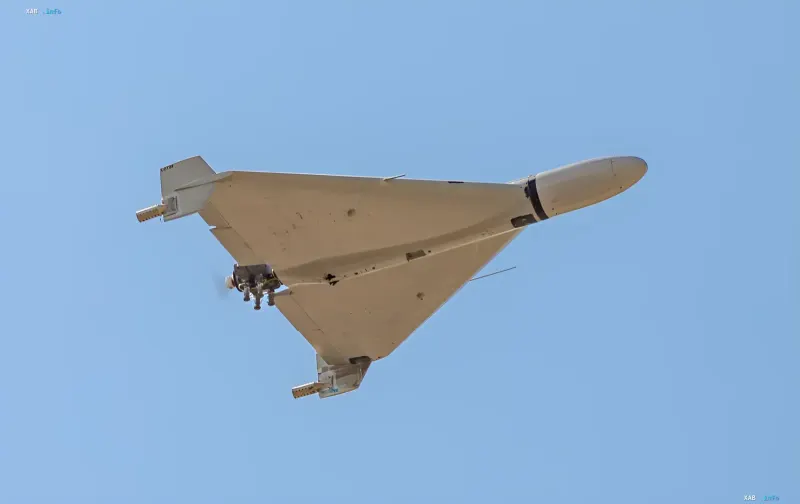
The question of whether weather affects the effectiveness of countering "Shahed" jet-powered drones comes up regularly in the public sphere, especially after mass attacks on Ukrainian cities. In the RBC-Ukraine podcast "TSE BAZA," co-founder of the company Contra-Drone Tymofiy Yurkov provided a detailed explanation of how atmospheric conditions interact with electronic warfare (EW) systems and the drones themselves. His key thesis is that for EW equipment, weather is a secondary factor, whereas for the operators and onboard guidance systems of the Shaheds, cloudy weather becomes a significant constraint.
EW remains largely unaffected by weather
Yurkov answered directly to the question of whether there is a pattern where the number of Shahed drones over Kyiv decreases in cloudy weather. According to his assessment, the impact of weather on drone suppression by EW is minimal. Air humidity can slightly weaken the effect of electronic suppression, but it is not a matter of "multiples" or tens of percent, but, as he says, "perhaps about half a percent." A similar picture is observed with radar systems: the efficiency of radio wave reflection decreases in adverse weather conditions, but only by fractions of a percent. Thus, the EW "dome" over the city remains operational regardless of whether it is raining, foggy, or the sky is overcast.
Optical navigation and cameras: weak points of the drone
The situation is quite different for the drone itself. Yurkov notes that bad weather does indeed complicate the task for the Shahed's operator or autonomous complex. The camera onboard the drone fogs up, droplets appear on the lens, which degrades the video stream quality. The optical navigation system, on which Shaheds rely heavily as they approach a target, begins to malfunction significantly. For a drone whose task is to hit a specific object accurately, the loss of clear optical contact with the target means a reduced probability of a hit or a complete miss.
Lower flight altitude as a vulnerability
Another important aspect pointed out by the expert is the change in the flight profile. In cloudy weather, Shaheds fly lower than on clear days. On the one hand, this is logical: the drone seeks to stay in an area where it is easier to navigate visually and where cloud density does not interfere with the camera. On the other hand, lowering the altitude makes the drone more vulnerable to detection by ground assets, interception by anti-aircraft systems, and suppression by EW, as the distance to the target is reduced and interception time increases. In essence, by trying to compensate for the degradation of its optical systems, the drone itself creates conditions under which it is easier to detect, shoot down, and suppress.
Strategic context: who benefits from the weather
RBC-Ukraine previously reported that, in addition to weather and EW, a shortage of crews also affects the effectiveness of intercepting Shahed drones. The Council of Armorers, in turn, evaluated rain, fog, and low cloud cover as factors that "blind" optical guidance systems, and noted that the enemy, according to the association, deliberately chooses such weather windows for attacks. Thus, a paradoxical picture emerges: weather simultaneously degrades the drone's onboard systems and hinders its operator, but can be used by the enemy as a tactical element, counting on the fact that the degradation of the optical guidance channel will reduce the accuracy of the strike on critical objects. Contra-Drone experts emphasize that for the defender, this is rather an additional argument in favor of a multi-layered air defense system, in which EW, anti-aircraft complexes, and optical assets work in concert to compensate for mutual limitations.
Practical conclusion for the defense system
The combination of factors described by Yurkov confirms that no single element of countermeasures—neither EW, nor radar, nor anti-aircraft systems—is a universal solution. Weather adjusts the performance of each of them, but these adjustments are asymmetrical: for defensive assets, they are measured in fractions of a percent, and for the attacking drone and its operator, in significant degradation of functionality. This means that during cloudy and rainy periods, a defense system built on a combination of EW, radar detection, and anti-aircraft fire theoretically works even better than in clear weather, as the enemy loses some of its navigation advantages. At the same time, as specialists emphasize, the critical issue remains not only technological but also organizational: having a sufficient number of trained crews and the coordinated work of all levels of air defense.