The World Economic Forum (WEF), in collaboration with Frontiers publishing, has released a new report listing ten technologies capable of significantly reducing harmful emissions, reducing dependence on key fossil fuel suppliers, and ensuring reliable energy supplies for more people by 2030. As the report's authors note, the necessary solutions already exist—in laboratories and pilot facilities—but their large-scale deployment into homes, factories, and power grids primarily requires funding. "More money is better," the researchers summarize, emphasizing that technical readiness is not the main limitation on the path to energy decarbonization.
Planetary Boundaries: Seven of Nine Already Exceeded
The report builds on research from the Potsdam Institute for Climate Impact Research (PIK), whose scientists proposed the concept of "planetary boundaries" back in 2009—a set of indicators for the state of Earth's key characteristics, exceeding which potentially threatens the sustainability of life on the planet. These parameters include ocean acidification, biodiversity loss, changes in the chemical composition of the atmosphere, and others. According to data cited in the report, seven of the nine planetary boundaries have been exceeded by 2026. Moreover, the vast majority of threats carrying the risk of exceeding these limits are linked to energy or sectors directly dependent on it.
Energy as a Systemic Factor
The way energy is produced largely determines the amount of carbon entering the atmosphere and the rate of ocean acidification. This, in turn, affects land, water, and mineral resource use, as well as how effectively communities cope with extreme heat and other climate shocks. That is why the report evaluates each of the ten technologies not only from the perspective of its direct impact on emissions, but also through the lens of its impact on planetary boundaries, social equity, and energy security. The authors weigh the pros and cons of each technology for the planet, for people, and for energy supply systems.
From Lab to Grid: The Deployment Challenge
"Many of the energy solutions we need already exist in laboratories. The challenge is to deploy them in homes, factories, and power grids quickly enough to make a difference," said Frederick Fenter, executive editor at Frontiers. According to him, open science accelerates the process by allowing engineers, corporate executives, and governments to build upon collaborative research results. The report is intended to provide reliable data to decision-makers working to strengthen energy security while simultaneously reducing climate damage.
Sand, Clay, and Rust: Unexpected Raw Materials
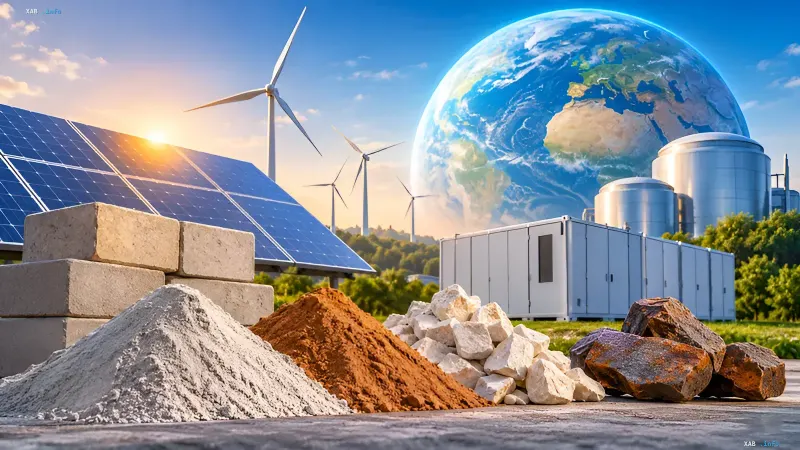
Among the ten technologies selected for the report are solutions that use materials currently perceived as waste or secondary resources as basic raw materials: sand, clay, and even rust. This approach reflects the general trend of the circular economy in energy—shifting from extracting new minerals to reusing substances already present in the environment and industrial waste. The visualization accompanying the publication clearly demonstrates this connection: in the foreground are heaps of sand, clay, ore, and stone; in the background are solar panels, wind turbines, modular energy units, and reactors; and above it all is an image of the Earth with exceeded planetary boundaries. It is both symbolic and substantive: the authors view the combination of "low-tech" raw materials with high-tech energy installations as the foundation of sustainable energy for the coming decade.
What's Next: Funding and Political Will
The main conclusion of the WEF and Frontiers report is that the technological barrier to decarbonization by 2030 has largely been overcome. Capital remains the limiting factor: scaling laboratory prototypes to an industrial level requires significant investment from both private business and governments. At a time when seven of the nine planetary boundaries have already been breached, the speed of deployment is becoming a critical parameter. The report is addressed primarily to those shaping energy policy and investment strategies, and is intended to serve as an evidentiary base for decision-making at national and international levels.