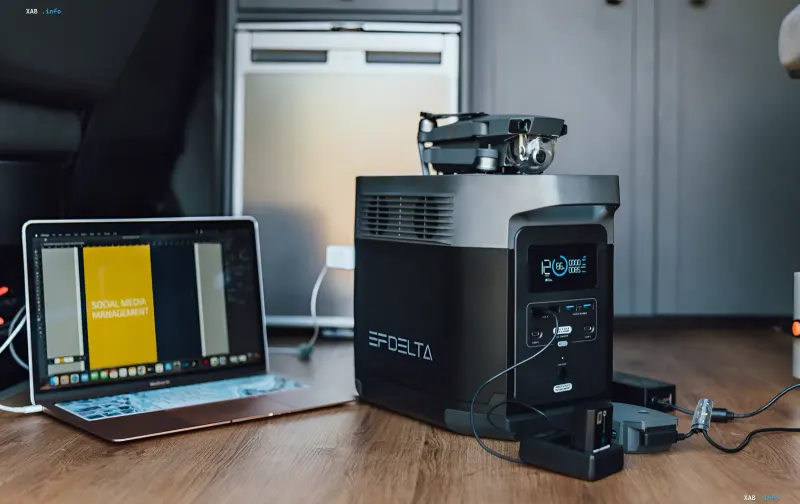
In the first months of mass power outages, Ukrainians bought up everything that could store electricity. A power bank found on a store shelf was already considered a lucky find, and a home power station seemed like a luxury. The main task was to charge a phone, turn on a laptop, or at least a few lamps. Over four years, the situation has fundamentally changed: many homes already have power banks, power stations, and router batteries. However, as Taras Martynyuk, head of the consumer electronics department at ASBIS-Ukraine, notes in an interview with RBC-Ukraine, having this equipment does not yet guarantee true autonomy. According to him, after years of working with portable electronics, he increasingly comes to one conclusion: "We have learned to store electricity, but we still do not always know how to use it wisely."
The charging time problem: eight hours versus two hours of power
A typical situation Ukrainians face during regular outages looks like this: electricity returns for two hours, but a full charge of a home station takes eight. A 30,000 mAh power bank is charged, but the laptop won't run off it. The router is powered by a battery, yet reboots every time the voltage drops. At the same time, the equipment may be fully operational — the user simply expects it to do something it wasn't designed for. Early generations of portable stations often charged slowly, and when power returned for a long time, this wasn't critical. But with short power supplies, the situation is drastically different: an older station of about 1 kWh can take around eight hours to charge, whereas modern systems with even higher capacity can restore charge significantly faster, depending on the model.
Lithium iron phosphate batteries and home grid limitations
Over four years, battery technology has also changed significantly. LiFePO4 lithium iron phosphate batteries have a high charge cycle resource, good thermal stability, and are widely used in modern stations. However, the charging speed is determined not only by the battery chemistry, but also by the station's electronics and the allowable input power. This is where a limitation that many buyers overlook comes into play: the capacity of the home electrical grid. In a 230V single-phase grid, a 16A circuit breaker corresponds to approximately 3.7 kW of power, 32A to 7.4 kW, and 50A to 11.5 kW. And this is the total load of the entire house. If the refrigerator, freezer, and other appliances turn on simultaneously when the power returns, charging the station will create an additional load. A 4 kW charging power already exceeds the rating of a 16A circuit breaker, which can cause accelerated wear. Therefore, according to Martynyuk's recommendation, one should take into account the capabilities of the home grid and, if necessary, limit the charging power in the station's settings, if such a feature is provided.
Power versus capacity: the main mistake when choosing
When choosing a power station, buyers first look at power and capacity: will it run the refrigerator, how many hours will the computer work. However, during regular outages, it is equally important how long the station itself needs to restore its charge. At the same time, power and capacity are fundamentally different parameters. Power determines what appliances can be connected simultaneously, while capacity determines how long they will run. Comparing stations solely by capacity is roughly like choosing a car exclusively by fuel tank size. A laptop, router, and lighting require one configuration; a house with a water pump and boiler requires another. Martynyuk recommends starting not with a catalog, but with a list of necessary devices, their consumption, operating duration, and the time available for charging between outages. Otherwise, even an expensive station may turn out to be a poor purchase.
The evolution of power banks: from 10,000 to 50,000 mAh and above
A few years ago, a 10,000 mAh power bank was enough for most people's smartphones. Today, according to ASBIS-Ukraine's observations, more and more buyers are choosing 20,000–30,000 mAh models. There is also demand for 40,000–50,000 mAh and higher — when you need to power several gadgets but don't need a full-fledged power station. The main change has happened in power output: power banks with 65W, 100W, 140W outputs can power not only phones, but also laptops. A 65W USB-C will suit many models with corresponding charging support, but for a more powerful laptop, this may not be enough. Buyers often confuse parameters: milliamp-hours characterize the energy reserve, not the charging speed. Two 20,000 mAh power banks can have different purposes — one will charge a smartphone, the other will allow you to work on a laptop. In addition, batteries gradually lose capacity, power banks are dropped and subjected to temperature fluctuations, and user needs are growing: yesterday it was enough to charge a phone, today you need to work on a laptop during an outage.
A practical checklist before buying
The combination of factors that Taras Martynyuk advises taking into account boils down to a few concrete steps. First, make a list of devices that need to be powered during an outage and determine their total energy consumption. Second, assess the duration of a typical outage and the time it takes for power to return — this determines whether the station will have time to charge between blackouts. Third, check the circuit breaker in the electrical panel and ensure that the station's charging power does not exceed the permissible load of the home grid. Fourth, do not confuse output power (what can be connected) with capacity (how long it will run) and input charging power (how quickly the station will restore its reserve). And finally, keep in mind that batteries degrade over time, and requirements for autonomy grow every year — equipment bought two years ago may no longer cover current needs.