Fall 2026 once again poses a question for gardeners that has no single universal answer: exactly when should winter garlic be planted so that a full harvest is ready by spring? According to Angelina Zdrok, director of the Garlic Seed Factory, relying solely on a calendar date is a mistake, because each year the weather arrives with its own scenario. The main task when planting in autumn is to catch the window in which the cloves have time to grow a root system before stable frosts set in, yet do not start actively putting out green shoots. It is precisely this "window" that determines the actual planting time, not a number on the calendar.
35–45 days: how long garlic needs to establish roots
According to Angelina Zdrok's recommendations, a garlic clove needs roughly 35–45 days for full preparation for winter. During this period it must form a strong root system — about 12–18 roots, 5–10 cm long. The better the garlic roots before the cold arrives, the higher its chances of surviving the winter period normally and producing a sturdy plant in spring. If autumn turns out warm and prolonged, it is better not to rush planting: a clove planted early in warm soil may start growing and form green shoots before the frosts, which sharply reduces its winter hardiness. Conversely, planting too late will not give the roots time to develop, and the garlic simply will not have time to prepare for the soil freezing.
Planting depth: why one hole for all cloves is a bad idea
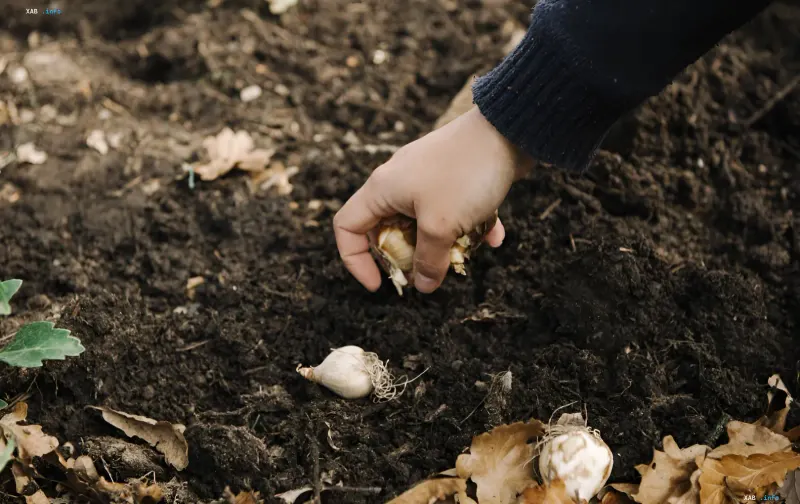
The second common question is how deep to bury the cloves. A practical benchmark for ordinary autumn planting is 5–8 cm, measured from the tip of the clove to the soil surface. However, larger cloves and light soils may require deeper planting. A simple rule given by agronomists: the lighter and drier the soil, the deeper you can plant; on heavy loam, cloves should not be buried too deeply. Planting too shallow risks freezing and death from sharp temperature swings, while excessive depth in spring delays the emergence of shoots. For a home garden bed, experts cite 6–8 cm from the tip of the clove to the soil surface as a good starting benchmark, adjusted for the specific soil type.
Contradictory data
Here it is worth noting a discrepancy in the figures that arises when comparing recommendations from different sources. The State Service of Ukraine on Food and Consumer Protection cites a depth of about 6–7 cm as a general recommendation for winter garlic. Specialized agronomic recommendations allow a range of 7–9 cm depending on conditions. At the same time, Styler (an RBC-Ukraine project), citing the Garlic Seed Factory, names a practical benchmark of 5–8 cm. A spread of 4 cm between the lower and upper limits looks significant, yet all three sources agree on one thing: the depth should be adjusted for the soil type and the size of the clove. There is no single "correct" number — there is a range within which the gardener chooses a reference point based on their own conditions.
Planting material and bed preparation: what determines the harvest
For autumn planting, select large and medium-sized healthy cloves without spots, damage, or signs of rot. A large clove carries a greater reserve of nutrients and is capable of forming a stronger plant. The State Service on Food and Consumer Protection also recommends using precisely large and medium cloves for planting. A separate mistake is taking garlic for planting straight from any head left in the kitchen: if the material regularly gets sick or shows signs of rot, the problem will be carried over to the bed. Before planting, it is better to break the heads into cloves immediately before planting, so that the base does not have time to dry out.
Location, predecessors, and acidity: details often overlooked
Garlic needs a sunny spot with well-drained soil where water does not stagnate. Good predecessors are considered legumes, cucurbits, cabbage, and cover crops. Garlic is not recommended to be planted after onions: these are related crops with common diseases and pests. Another nuance that gardeners often forget is soil acidity. According to the Garlic Seed Factory, optimal soils are light loamy and sandy-loam chernozems, and acidic soils should be limed before growing garlic. Thus, autumn garlic planting is not simply "beating the frosts," but a complex calculation: the right planting material, a prepared bed, and above all — giving the garlic enough time for root development, without turning the autumn planting into a premature spring start.