The prolonged autumn rains that once again cover a significant portion of orchard regions in 2026 create more than mere discomfort for apple and pear trees — they form conditions under which a fungal infection continues to develop actively even at the end of the season. Characteristic spots appear on the leaves and fruit, which many gardeners mistake for ordinary leaf aging or mechanical damage. However, according to experts, this may be scab — a disease capable of overwintering in the orchard and triggering a powerful new cycle of infection the following spring.
What scab is and why it does not "sleep" after the rains
Scab of fruit trees is caused by the fungus Venturia inaequalis. For infection to occur, the spores need moisture on the plant's surface: prolonged periods of rain or wet leaves create a favorable environment for spore germination and for the mycelium to penetrate the tissues. Kerry Peter, PhD, a fruit tree pathology specialist at Penn State Extension, emphasizes that although scab is traditionally considered an early-season problem, late-season infections are possible under persistently wet weather. This is especially relevant in September, when the fruit is already approaching harvest and prolonged precipitation prevents the leaves from drying out.
How to recognize scab on leaves and fruit
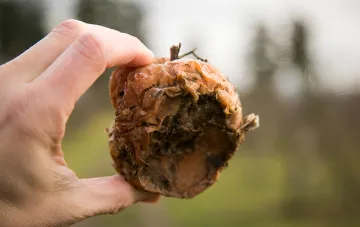
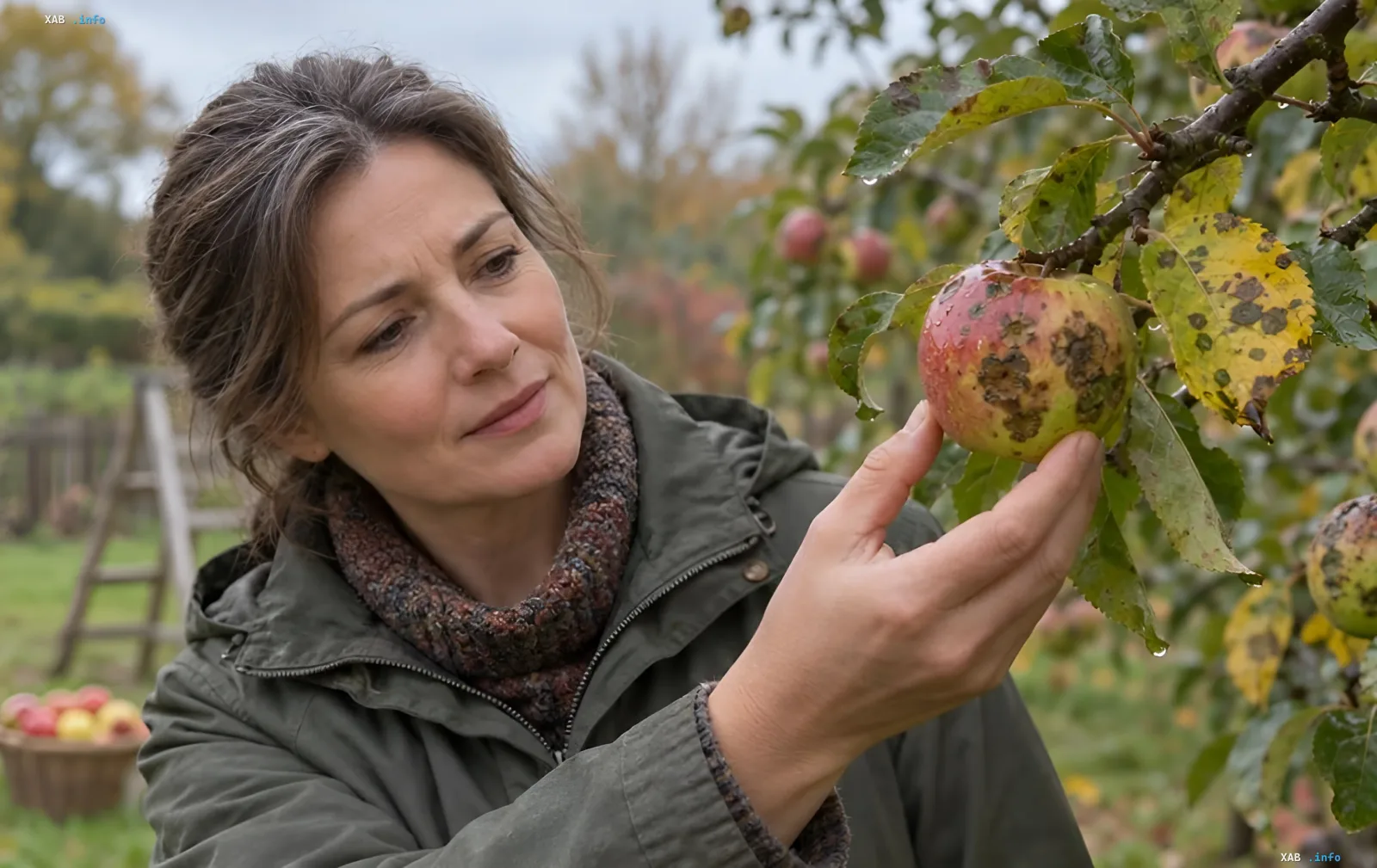
On the leaves, the disease first appears as small olive-green spots. Over time they darken, taking on a brown or black hue, while the leaf blade yellows and drops prematurely. On the fruit the picture is different: darker, gradually corky spots form. Young apples may become deformed, cracked, or stop growing when the infection appears. Photos from orchards show that affected fruit lose their marketable appearance and become a source of spores for further spread.
The main autumn task — remove the source of infection
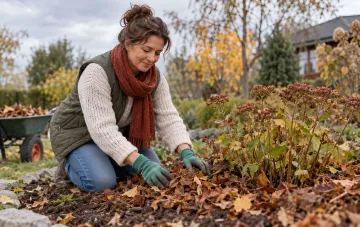
If there are already signs of scab on the tree, specialists at the University of Minnesota Extension advise first and foremost focusing on sanitary cleanup. The key autumn problem is fallen infected leaves: it is in them that the fungus overwinters and builds up a reserve of spores for a new cycle of infection in spring. It is undesirable to leave such a layer of leaf litter under the tree. Reducing the amount of infected plant debris directly shrinks the pool of spores that could become a source of infection in the next season. Pruning the canopy plays an additional role: an open canopy dries out faster after precipitation, and a shorter period of leaf wetness reduces the favorable conditions for fungal infections.
Chemistry is no panacea: when and how to apply it
It is important not to rush to treat with fungicides simply because it has rained. The main period of scab prevention falls in spring, when spores are released from the fallen leaves. In autumn, for a home orchard, a far more important part of care is sanitary cleanup and accelerating the decomposition of leaves. If treatment is truly necessary, one should rely exclusively on a product registered for the corresponding crop, strictly follow the label, the rate, and the pre-harvest interval. In particular, in Ukraine the product "Score 250 EC" is registered for apple against scab and powdery mildew; however, the manufacturer explicitly specifies the exact rates, the allowable number of treatments, and the pre-harvest interval. Treating apple trees "just in case" with the same product after every rain is not only pointless but can also contribute to the development of resistance in the fungus.
How much does fighting scab in a home orchard cost
The most affordable way to reduce the risk of scab is to buy nothing at all, but to remove and shred the fallen leaves in a timely manner. If a tool is needed, prices on the Ukrainian market vary: simple garden pruners are available for roughly 140–180 hryvnia, while professional models cost over 1000 hryvnia. The cost of plant protection products varies significantly depending on the product, the package size, and the store, so for a home orchard it is more accurate to calculate the price of the whole one-liter canister and the actual dose per tree. In the end, the most important autumn task is to reduce the amount of infection that will overwinter in the orchard: this is what will most largely determine the scab situation the following spring.