Autumn garden care in October 2026 requires owners of country and suburban plots to pay special attention to protecting fruit trees. Whitewashing apple, pear, and cherry trees is a traditional and highly important agrotechnical procedure that helps prepare plants for the upcoming winter cold. However, the effectiveness of such protection depends not only on the chosen mixture, but also on the overall condition of the tree, weather conditions, and strict adherence to the application technology.
Protection Against Temperature Fluctuations and Sunburn
The main task of autumn whitewashing is not aesthetic decoration of the garden or frost protection, as many novice gardeners believe. Experts from Purdue University and the University of Maryland note that light-colored coatings effectively reflect sunlight on clear winter days. Without this, the bark of young trees with a thin structure heats up significantly during the day and cools down rapidly after sunset. Such fluctuations cause deep cracks and tissue death beneath the bark, which the protective layer is designed to prevent.
Optimal Timing and Weather Conditions
Choosing the right time for the work plays a key role in the successful wintering of the garden. According to recommendations from the State Prodspivzh служба of Ternopil region, the procedure should be carried out after active tree growth has stopped and leaf fall is complete, but before steady frosts set in. In October and November 2026, gardeners need to focus on dry weather. If it is raining, there is no need to rush into whitewashing solely because of the calendar — it is better to wait for weather conditions to stabilize, as moisture will negate all efforts.
Contradictory Data
There are certain discrepancies in the expert community and various agronomic sources regarding the frequency of whitewashing and the universality of its application. Some specialists insist that the procedure is a mandatory annual measure for absolutely all fruit crops in the garden. At the same time, materials from the University of Connecticut and the University of California Integrated Pest Management Program emphasize that mature trees with thick, strong bark are less vulnerable to sunburn and do not require annual coating renewal. In addition, opinions differ regarding additives: some sources allow the use of copper sulfate and glue for better adhesion, while others strongly advise against experimenting with homemade components without precise dosages.
Choosing the Composition: Lime or Ready-Made Paint
The range of bark protection products today is quite wide, and the choice depends directly on the age of the specific plant. The State Prodspivzh служба of Poltava region recommends using gentle garden paint for young seedlings up to three years old, as an aggressive lime solution can cause chemical burns to delicate bark. For mature trees, lime solutions are permitted, but their concentration must be calculated extremely precisely. It is important to strictly follow manufacturers' instructions and avoid adding random components like glue or copper sulfate on a whim.
Preparation and Application Rules
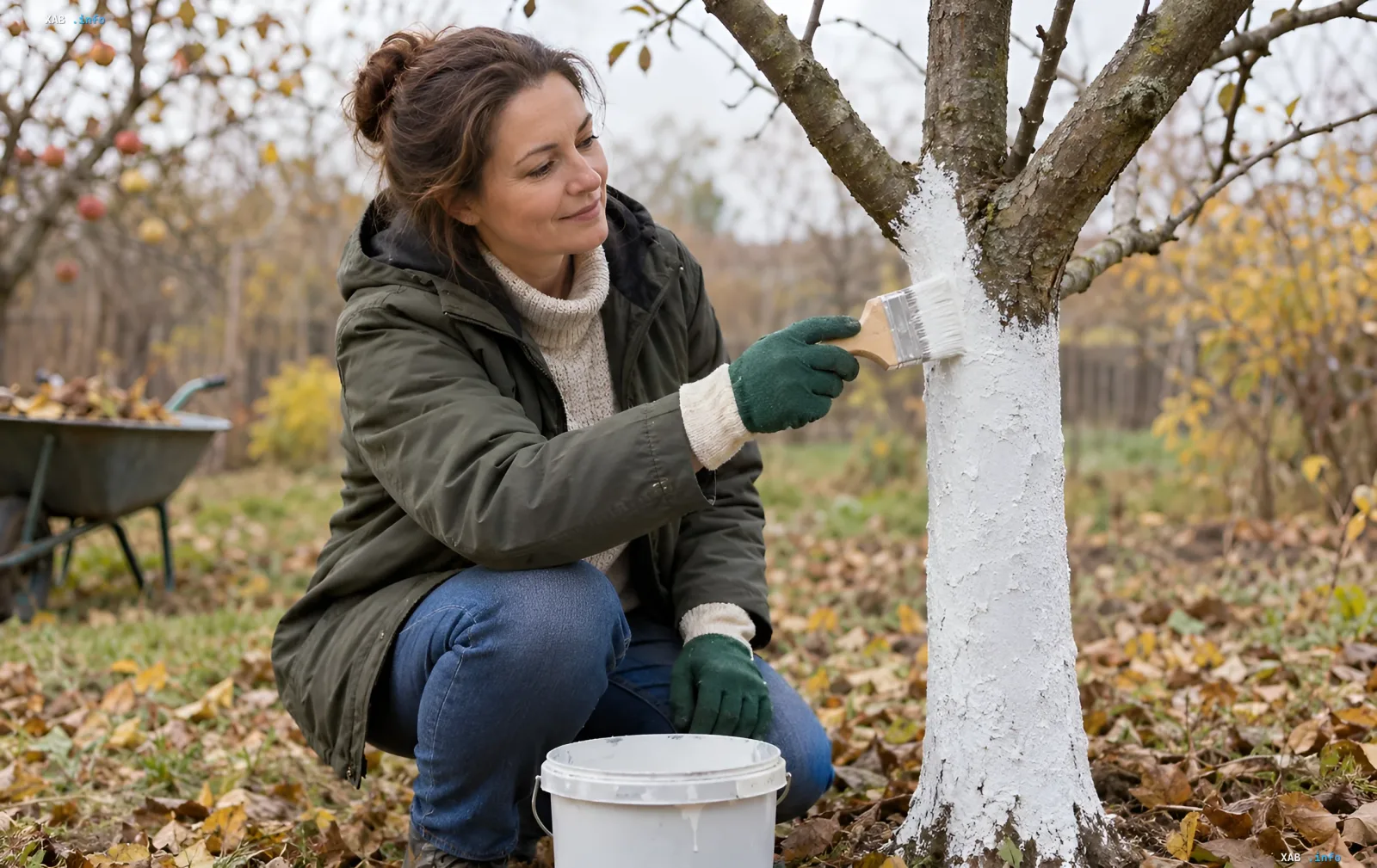
Before beginning trunk treatment, a thorough inspection of the trees for cracks, hollows, or signs of rodent activity must be performed. Carefully removing only dead, easily peeling bark is permitted without the use of rough metal tools that could inflict additional trauma on living tissues. The mixture is applied in an even layer from the soil base to the lower skeletal branches, preventing runs. Once dry, the coating should hold firmly to the surface, providing reliable garden protection throughout the 2026-2027 winter season.