Door squeaking is one of those household annoyances that can drive you crazy even in a recently renovated apartment. In most cases, the unpleasant sound can be eliminated in just a few minutes; however, in certain situations, regular lubrication does not help and instead points to more serious hardware wear or door leaf deformation. The editorial team of Styler (RBC Styler) has broken down the main causes of squeaking, diagnostic methods, and types of lubricants that actually work.
Six main causes of door hinge squeaking
Most often, the source of the unpleasant sound is the friction of metal door hinge parts. With every opening and closing, they undergo cyclical motion, while the factory or previously applied lubricant gradually loses its properties or gets contaminated. However, squeaking does not always mean that simply applying oil is enough. Experts identify several typical causes: lack of lubrication, causing metal parts to rub against each other and produce a characteristic high-pitched sound; accumulation of dust and dirt inside the mechanism, preventing smooth movement; rust, which accelerates in humid rooms like bathrooms and kitchens; loose screw fastenings, causing the door to shift and rub against the frame; door leaf misalignment due to improper installation, sagging, or deformation; and hinge wear, where damaged or loose parts provide only a temporary effect after lubrication.
Diagnostics: how to figure out where the squeak is coming from
Before grabbing a can of lubricant, it is important to identify the source of the sound—this helps avoid unnecessary work and prevents masking the real problem. Experts from The Home Depot, referenced by Styler, recommend inspecting the hinges, checking the hardware, and making sure the door is not catching on the frame or floor before performing any manipulations. A practical algorithm looks like this: slowly open and close the door several times, noting the exact moment the squeak occurs. If the sound accompanies the entire movement and the door opens without noticeable resistance, the cause is most likely the hinges. If the squeak appears only in a certain position, the door binds, or requires extra effort, you should check the fit against the frame. Uneven gaps between the door leaf and frame indicate misalignment, traces of friction on the wood or paint indicate direct contact, and squeaking combined with wobbling points to loose fasteners. A reddish coating on the metal indicates corrosion. A simple household test involves running a sheet of paper along the gap between the door and the frame—if the paper gets pinched in any spot, that is precisely where the friction occurs.
What lubricants to use: four working options
The choice of lubricant depends on the hinge design, their condition, and operating conditions. Lithium grease is a thick substance that reduces friction and protects metal from corrosion; due to its consistency, it stays on moving surfaces longer than liquid alternatives, making it suitable for frequently used doors. It should be applied moderately so excess does not attract dust. Silicone products usually come in spray form and form a thin film that reduces friction; they are convenient to spray onto hard-to-reach parts of the mechanism. Before use, it is important to check the instructions, especially if the hinges contain plastic elements or decorative coatings. Graphite powder belongs to dry lubricants: it leaves no greasy film but can leave dark marks, so it must be applied carefully near light-colored doors and flooring. Finally, light technical machine oil is a simple and affordable option: for a regular hinge, a few drops that penetrate between moving parts are enough. The key condition is to use technical oil, not food oil.
Step-by-step guide to fixing the squeak yourself
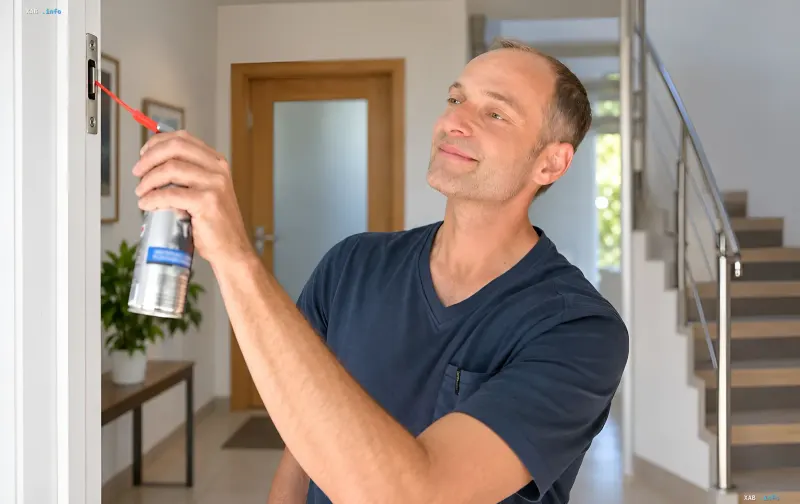
If the hinges are not damaged and the door is not misaligned, the problem can usually be solved without calling a professional. For the job, you will need a soft cloth, a suitable lubricant, a small brush, and, if necessary, a screwdriver. The procedure: first, inspect the hinges for damage, rust, and loose screws; then clean the mechanism of dust, dirt, and old lubricant residue using a brush; protect the floor by placing a napkin or cloth under the hinges to prevent stains; apply the chosen product to moving surfaces; open and close the door several times to distribute the lubricant throughout the stroke; wipe away excess with a soft cloth. After this, the squeak usually disappears. However, if the sound persists after all manipulations, the door continues to bind or noticeably wobble, it is a sign that the hardware needs replacing and the leaf needs realignment—and professional intervention is unavoidable at this point.
When lubrication is powerless
It is important to understand the limits of DIY repair. Lubrication eliminates friction but does not restore geometry. If the hinges have excessive play, are deformed or destroyed, applying any product will only give a temporary effect. Similarly, door leaf misalignment caused by frame settling or door deformation cannot be fixed with lithium grease or silicone spray. In such cases, it is necessary to either adjust the hinges and fasteners, replace the hardware, or perform more serious repairs on the door unit. As experts emphasize, preliminary diagnostics—inspection, checking gaps, the paper sheet test—allow you to avoid wasting time and money on lubrication where mechanical repair is required.