Lighting flickering in an apartment is one of the most common household problems, which can be either harmless or a signal of a serious electrical grid malfunction. According to Landmark Electric specialists, the nature of the flickering helps determine the direction of inspection, but does not identify the cause on its own. Before taking any action, experts recommend noting three parameters: exactly when the flickering occurs, how long it lasts, and which appliances were turned on at that moment. Repeatedly turning appliances on and off to "reproduce" the problem is strictly discouraged, as it can worsen the malfunction.
One light fixture flickers: start with the bulb
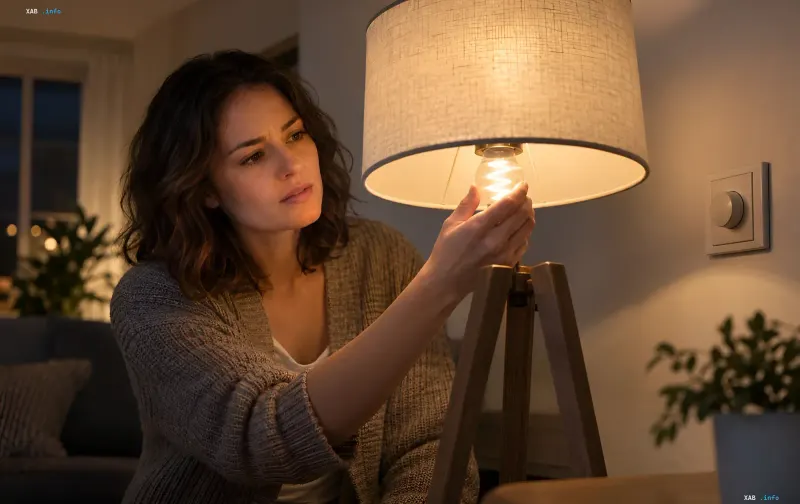
If only one light source is flickering, Lilliput Electrical specialists advise starting by replacing the bulb. However, this is permissible only under certain conditions: the fixture must have a replaceable bulb, it must be safely accessible, and there must be no burning smell, crackling, sparking, or visible wiring damage around it. If the flickering disappears after replacement, the problem was in the bulb itself or its contact in the socket. If the flashing persists, you must turn off the fixture and call an electrician. Do not attempt to disassemble the socket or bend the contacts yourself under any circumstances.
Dimmer and LED bulb: hidden incompatibility
A frequent cause of flickering is the incompatibility of the dimmer switch with the installed bulb. The "dimmable" label on an LED bulb package does not guarantee correct operation with every dimmer. Manufacturer documentation, such as that from Philips, publishes specific compatibility lists that should be checked before purchasing. Important: replacing the dimmer itself must be performed only by a qualified specialist, not by the resident independently.
Coincidence with heavy appliance startup: a sign of overload
If light flickering coincides in time with the startup of a refrigerator, air conditioner, or other power-hungry appliance, AB Electrical explains, this may indicate a problem with network load, the condition of electrical connections, or the building's power supply. In this situation, self-action is limited to noting the time and contacting an electrician who will check the load and connections. Inform the specialist if the flickering started recently, is worsening over time, or affects multiple fixtures — these details are critical for diagnostics.
Red flags: when every minute counts
Regardless of the nature of the flickering, there is a set of signs requiring immediate action. If smoke or a burning smell comes from an outlet, switch, or light fixture, stop using the problematic equipment and call an electrician immediately. If you know for sure which circuit breaker controls that line, the panel shows no signs of malfunction, and it is safely accessible, de-energize the corresponding line. Do not touch suspicious outlets and switches to "check if they are hot." If smoke or open flames appear, leave the premises and call 101. The SES (State Emergency Service) specifically reminds: equipment under voltage must not be extinguished with water.
Where to apply and what to do after power restoration
According to DTEK, in-house electrical networks are maintained by the organization responsible for building maintenance. The presence or absence of the problem in neighbors helps specialists in diagnostics, but does not prove by itself where the malfunction occurred. After power restoration, according to the Hlukhiv City Council memo, do not turn on all powerful equipment simultaneously: start energy-intensive devices one by one. If lighting flickers again or appliances behave unusually, immediately turn off sensitive electrical devices. If the flickering does not disappear or repeats, report it to an electrician or distribution system operator to prevent a recurrence.