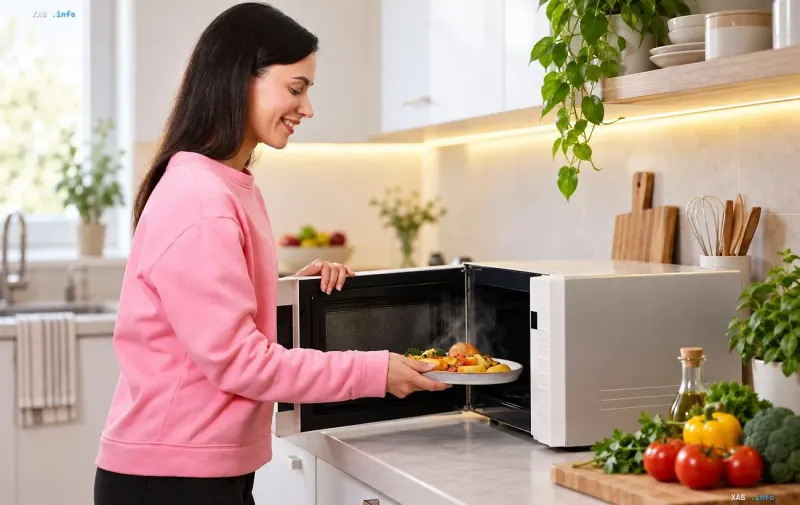
Sometimes after being heated in a microwave, food turns out hot on the outside while remaining lukewarm inside. This situation does not necessarily indicate a device malfunction, as the result is influenced by heating physics, portion size, and even the shape of the dishes. Experts from specialized publications and agencies explain why this problem occurs and how to make reheating more effective and safe.
The physics of the process and wave distribution
A microwave oven operates using electromagnetic waves that transfer energy to water molecules and other components of food, causing them to vibrate and generate heat. However, microwaves are distributed unevenly inside the chamber, causing one part of a dish to heat faster while another remains insufficiently warm. To reduce this difference, most appliances are equipped with a rotating turntable, but even it does not guarantee an ideal result.
As specialists note, the problem is especially noticeable in dishes consisting of various ingredients. For example, liquid sauce heats significantly faster than dense meat fillings or side dishes. A common mistake is placing food in a high mound in the middle of the plate, where the periphery absorbs maximum energy while leaving the center cold.
Rules for layout and mechanical stirring
To ensure food heats more evenly, experts recommend spreading products across the plate in a roughly uniform layer and cutting large pieces into smaller fragments when possible. When reheating loose items like rice, pasta, or vegetables, making a small indentation in the center of the portion is useful. It is also necessary to ensure that overly large containers do not block the rotation of the tray.
Even with a rotating plate, stirring the dish during the process is desirable. According to food safety recommendations, pausing the oven midway through the cycle to stir soups, porridges, or stews significantly evens out the temperature. Items that cannot be stirred, such as meat, should be turned over or rearranged.
The role of protective lids and holding time
Another useful habit is using a dedicated microwave lid. As culinary analysts emphasize, covering the dish prevents food from drying out and protects the interior from splashes. The steam generated under the lid promotes more even heat distribution, although containers must not be sealed airtight.
After the appliance stops, food should not be served immediately. Heat continues to propagate inside products for some time after the magnetron turns off. This stage, called holding time, allows the temperature of internal and external layers to equalize naturally.
Importance for food safety and hygiene
Heating uniformity is critical not only for taste but also for food safety. If individual parts of a dish remain insufficiently heated, harmful microorganisms may survive. According to food safety standards, reheated ready-to-eat dishes must reach a temperature of 74 degrees Celsius throughout their entire volume.