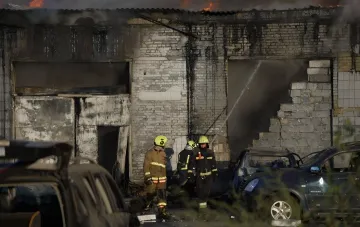
From a technical standpoint, Russian military forces are capable of striking Kyiv using the 'Banderyol' (S8000) reactive munition, yet they have so far not employed this weapon against the Ukrainian capital on a mass scale. This was stated in a comment to RBC-Ukraine by aviation expert Konstantin Krivolap. According to him, it is difficult to name the exact limitations in this regard, but he considers the most likely cause to be organizational and staffing factors: the deployment of combat units and the segmentation of responsibility zones that Russian forces have established within their strike system.
What Is the 'Banderyol'
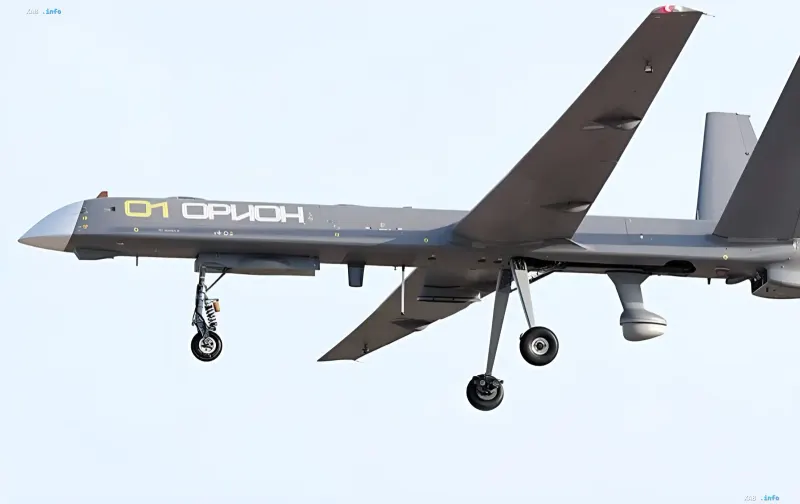
The 'Banderyol' (designation S8000) is a Russian reactive penetrating munition, which the Main Directorate of Intelligence of the Ukrainian Ministry of Defence additionally classifies as a cruise missile. In essence, it is a hybrid of a drone and a missile, developed by the Russian company JSC 'Kronstadt'. The primary launch platform is the Russian 'Orion' UAV, from which the munition is dropped and its jet engine is ignited. Meanwhile, as observers note, Russia is actively seeking ways to diversify its use — in particular, the possibility of launching the 'Banderyol' from ground launch platforms is being discussed, which would expand the geography and density of strikes.
Why Kyiv Is Not Yet Under Mass Fire
In Konstantin Krivolap's assessment, the matter presumably lies in the different responsibility zones of individual combat units that have 'Banderyol' munitions in their arsenal. The expert emphasizes that it is difficult to determine exactly which limitations apply to the Russians: this may be related both to the physical deployment of strike groupings and to the internal distribution of tasks between units. In other words, the absence of massive strikes on the capital, according to his version, does not necessarily mean a technical inability — rather, it is a consequence of how the segmentation of responsibility for individual directions and targets is organized.
Specifications and Tactics of Use
The maximum range of the 'Banderyol' is about 500 km, and its maximum speed is up to 650 km/h. Thanks to its jet engine, the munition is capable of maintaining a speed of around 600 km/h on the march and descending to an altitude of about 200 meters before the strike, which makes it a difficult target for short- and medium-range air defense. According to Krivolap, the 'Banderyol' was first used against Kyiv in June 2026, after which the use of this munition against Ukraine as a whole became more frequent. The photo shows the 'Orion' UAV — the standard aerial launch platform for this hybrid munition.
Contradictory Data
The available statements and descriptions contain minor discrepancies in the figures and in the classification of the weapon itself. Thus, the maximum speed is given as 'up to 650 km/h' in some formulations and 'around 600 km/h' in others; presumably, the former refers to the maximum speed and the latter to the typical cruise speed, but no single precise value has been recorded in open sources. Moreover, the object itself is named differently: the developer and some experts call it a reactive penetrating munition, the GUR of the Ukrainian MoD calls it a cruise missile, and analysts interpret it as a hybrid of a drone and a missile. These differences in terminology and figures should be taken into account when assessing the real capabilities of the munition.
Vulnerability to Ukrainian Air Defense
Despite its high speed and low profile at the terminal stage, the 'Banderyol' is not invulnerable to Ukrainian air defense. As aviation expert Anatoly Khrapchinsky noted, in terms of flight profile this drone-missile corresponds to a cruise missile or a jet drone. At the same time, its mass use creates an additional load on air defense precisely in the class of air-launched missiles, that is, it forces the defense system to distribute limited anti-aircraft assets among several types of threats simultaneously. Thus, the 'Banderyol' represents a real but not absolute threat, and its effectiveness against specific targets, including Kyiv, largely depends on how the responsibility zones and the density of strike groupings are organized.