A wool sweater remains one of the most practical items in an autumn-winter wardrobe: it retains heat well, does not build up static electricity, and looks neat. However, even expensive 100% wool clothing often causes itching, pricking, and skin irritation, leading many owners to leave it in the closet. According to Styler, the problem lies not in the quality of the item or an allergy, but in the physical properties of the fibers themselves and how they interact with the skin during contact.
Fiber thickness is the main factor of itchiness
In a scientific review published in the journal Acta Dermato-Venereologica, researchers established that skin irritation is most often caused by wool fibers with a diameter of 30 to 32 micrometers (a micrometer is one-thousandth of a millimeter). Imagine dozens of tiny hairs with tips protruding from the fabric surface: when they touch the body, they press against the skin. Fine fibers bend easily and do not cause discomfort, while thick ones remain rigid and provoke a prickling sensation. This is why two sweaters made of the same composition of wool can feel completely different on the body. A study published in Emerald adds to the picture: itchiness is influenced not only by fiber diameter but also by the knitting structure — some types of textured knitwear irritate the skin more than smooth surfaces.
It is not an allergy, but a mechanical reaction
It is important to understand that pricking from wool is, in most cases, not an allergic reaction. It is a mechanical irritation: the rigid tips of the fibers physically affect skin receptors. However, individual sensitivity to fabric components is possible, especially in people with dermatological conditions, who may experience significant discomfort even from materials usually considered delicate. If you experience pronounced redness, rashes, or persistent itching after wearing a sweater, you should consult a doctor to rule out contact dermatitis.
How to wash wool properly: Woolmark recommendations
It is impossible to completely change the structure of coarse wool at home, but proper care can noticeably reduce discomfort. Ordinary washing powder with aggressive components is not suitable for natural wool: it damages the fibers, and detergent residue after insufficient rinsing worsens the sensation from the fabric. The Woolmark organization recommends using mild detergents with a neutral pH level and avoiding bleach, as well as powders containing enzymes. If the label allows machine washing, choose a special program for wool; if the manufacturer specifies dry cleaning only, it is not worth experimenting with home washing. Fabric conditioner can change the tactile properties of the fabric, but it must be used in moderation: according to Woolmark recommendations, softening agents should be added during the final rinse, and an excess of them can promote pilling because the fibers move to the surface more easily.
Drying and myths about freezing and vinegar
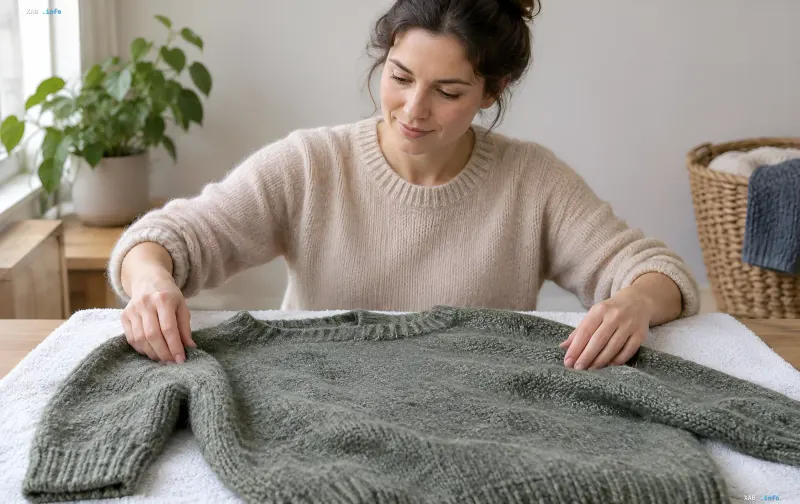
Proper drying is just as important. A wet wool sweater should not be placed on a radiator, hung on a hot dryer, or left in direct sunlight. Woolmark specialists advise drying knitwear horizontally, away from direct heat sources: smooth out the item on a towel, restore it to its original shape, and leave it to dry completely — this will prevent stretching and deformation. Online, there are often tips to put a sweater in the freezer or soak it in a vinegar solution. However, there is no convincing scientific evidence that freezing can permanently rid wool of its itchiness: low temperatures do not change the diameter of rigid fibers. Vinegar is not a universal softening agent either — even if the fabric feels nicer to the touch after treatment, its natural structure does not change. A popular hack involving soaking in hair conditioner also has no reliable evidence of effectiveness, and the fiber thickness remains the same after such treatment.
A practical solution if the sweater is still itchy
Sometimes, even after delicate washing and proper drying, wool clothing continues to irritate the skin. In this case, it is most likely the natural rigidity of the fibers rather than improper care. The simplest and safest solution is to wear a thin cotton long-sleeve or T-shirt underneath the sweater: an additional layer creates a barrier between the wool and the skin. Pay special attention to the collar and cuffs, as these are the areas where the knitwear fits tightly to the body and the prickling is felt more strongly. Ultimately, the most reliable rule is to follow the manufacturer's instructions and use products specifically designed for wool care, rather than general household cleaners.