
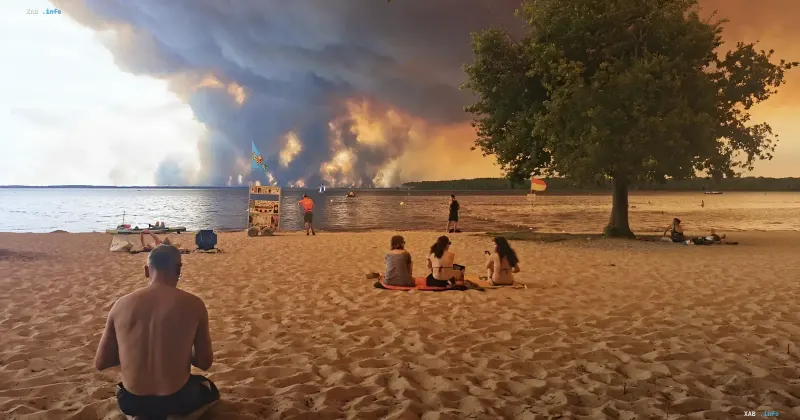
The image, taken on a beach in Lacanau, France, shows a chilling contrast: tourists relaxing on the sand against a fiery sky choked with thick smoke from wildfires. This image has become a symbol of the summer of 2026, when intense heatwaves and droughts swept across France and Spain, demonstrating the scale of the consequences of climate change for Europe.
Climate as a catalyst for disasters
According to an analysis by the World Weather Attribution (WWA) organization, anthropogenic climate change has radically altered the weather realities of the continent. The probability of hot, dry, and fire-prone conditions in central Spain has increased by approximately 20 times. In southwestern France, where Lacanau is located, this risk has doubled.
The report "State of the Climate in Europe by 2025," prepared by the Copernicus Climate Change Service and the World Meteorological Organization (WMO), confirms alarming trends. Europe is recognized as the fastest-warming continent on the planet. Statistics for the period from 1996 to 2025 show that land surface temperatures here rose at a rate of 0.56 degrees Celsius per decade, which is almost twice the global average of 0.27 degrees. Compared to pre-industrial levels, warming in Europe has already reached about 2.5 degrees Celsius.
The physics of accelerated heating
The main cause remains the emission of greenhouse gases from burning fossil fuels, but there are also specific factors accelerating the process specifically in Europe:
- Difference in heating between land and sea. Unlike the ocean, which cools through evaporation, land absorbs heat much faster. In conditions of moisture deficit, characteristic of droughts, this effect is intensified.
- Proximity to the Arctic. Europe is located near the Polar Circle — the region of the fastest warming. Melting ice and snow expose dark surfaces that absorb solar heat instead of reflecting it, creating a vicious cycle of global warming.
- Improvement in air quality. Paradoxically, stricter environmental regulations and the reduction of industrial aerosol emissions, which previously reflected some sunlight, have led to more radiation reaching the surface, making the greenhouse gas effect more noticeable.
The future without extreme phenomena
The Copernicus Service notes that changes in atmospheric circulation are making summer heatwaves more frequent and prolonged. In Southern Europe, solar energy heats the surface rather than evaporating water, intensifying the "oven" effect.
Scientists warn that the current trend leads to an extension of the wildfire season, drying up of rivers, and shrinking glaciers. If greenhouse gas emissions are not drastically reduced, in the coming decades Europe will face even more extreme weather events, similar to those recorded on the beach in Lacanau.