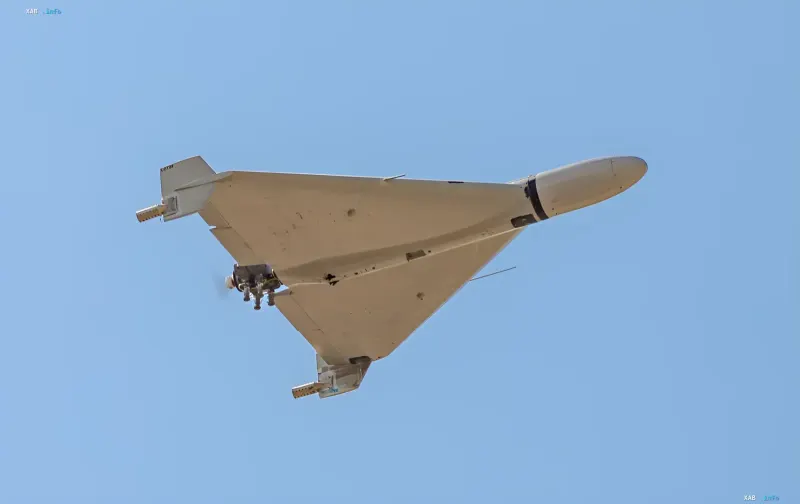
According to The Wall Street Journal, as cited by RBC-Ukraine, Moscow has managed to ramp up production of a new generation of relatively inexpensive yet highly precise unmanned systems faster than Ukraine and the US have been able to scale up their own production of comparable weapons. The drones in question are of the "Geran" type and the "Bandierol" drone-missiles, which, according to the publication, demonstrate that Russia still possesses the resources and supply chains to create new military threats — this time in the form of weapons equipped with advanced electronics capable of precisely homing on a target and evading interception.
Breakthrough in Cheap, High-Precision Weapons
Analysts and diplomats quoted by WSJ emphasize that both types of weapons were developed and adopted within just a few years: Moscow modified earlier models, conducted combat testing, and quickly moved to serial production. Estimates put the cost of each "Bandierol" and "Geran-5" drone-missile at around $100,000, whereas Western cruise missiles such as the Tomahawk and comparable models cost more than $2 million each. Thus, the new Russian weapons occupy what is called the "economic sweet spot" — the niche of cheap but effective single-use weapons that both Ukraine and Western countries are striving to enter.
Chinese Components and the Sanctions Question
The publication notes that the breakthrough was made possible largely by components supplied from China, which, according to Kyiv and several other parties, constitutes a violation of international sanctions. China's involvement, as Ukraine claims, is confirmed by the debris of several already shot-down drones. This turns Moscow's technological edge into a diplomatic problem as well, tied to circumventing the sanctions regime through third countries.
Moscow's Adaptability vs. Western Restrictions
By acting in this way, Russia, in the view of experts, has gotten ahead of its adversaries. Ukraine, for its part, has demonstrated the ability to act quickly — it developed one of the first effective jet-powered drones — but it lacks the production resources and broad capacity for long-term planning. The US and its NATO allies, by contrast, are struggling to ramp up production of critical weapons, including interceptor missiles for the Patriot air defense system, and are grappling with how to speed up the conversion of innovations into serial equipment.
Contradictory Data
It is important here to compare two versions. On the one hand, WSJ paints a picture of a continuous technological breakthrough and Moscow's sustained lead in serial production of new models. On the other hand, Ukrainian intelligence (GUR) had previously recorded a temporary halt in the production of "Geran-3" drones, attributing it to a transition to new modifications, and named its own plans for the volume of strike drone output. These data do not directly contradict each other, but they create a discrepancy in interpretation: a pause in the production of older "Geran" drones can be read both as a planned transition to "Geran-5" and "Bandierol" and as a sign of constraints in supply chains. Both viewpoints are set out in open sources, and the final conclusion on the continuity of production remains a matter of assessment.
Impact on Global Security
WSJ notes that events in Moscow directly affect the US as well, since Russia, Iran, and North Korea are exchanging military knowledge. In parallel, innovations borrowed from the war in Ukraine are finding application in conflicts involving Iran, and vice versa. Thus, the race in the segment of cheap, high-precision weapons is ceasing to be local and is becoming a factor affecting the balance of power and how different states turn combat experience into serial production.