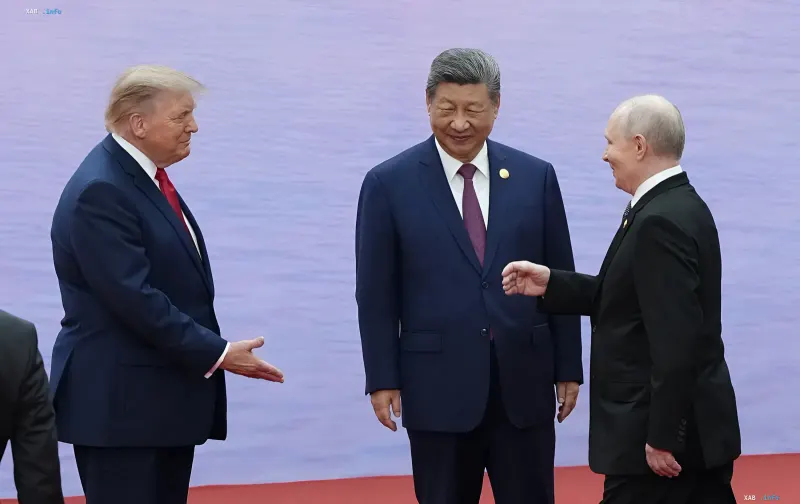
On the sidelines of the APEC summit, the first-ever trilateral meeting took place between the leaders of Russia, the USA, and China — Vladimir Putin, Donald Trump, and Xi Jinping. According to an informed source in diplomatic circles familiar with Kyiv's position, the very fact of such a format is a "bad precedent for Ukraine and Europe that could become a practice." The biggest concern, according to the RBC-Ukraine source, is not so much the joint photo, but the bilateral negotiations that the leaders held during the same visit.
"A bad precedent that could become practice"
"We have great concerns about the bilateral meetings. As for the Xi-Trump-Putin format, the very fact of such a meeting is a bad precedent for us and for the Europeans, which could become a regular practice," the source said. According to them, even though China, in Kyiv's assessment, is not seeking open intervention in the settlement, it will be impossible to avoid discussing Ukraine within such a format. Diplomats emphasize: if the three powers regularly gather leaders at one table without the participation of the direct parties to the conflict, this will be established as a stable norm of foreign policy.
Beijing's Role: A Moderator Without Clear Positioning
According to the same source, Xi Jinping will likely seek to act as a moderator of the discussion, avoiding clear positioning on key issues. "Most likely, the thesis will be voiced that if the negotiations advance, China at a certain stage could consider the possibility of its own involvement in the peace process," believes the RBC-Ukraine source. Thus, Beijing retains an option to participate in the settlement without locking in specific obligations.
Bilateral Talk Between Trump and Putin
Before the trilateral format, Donald Trump and Vladimir Putin held separate talks. According to Kremlin aide Yuri Ushakov, the leaders discussed the war in Ukraine and bilateral relations. At the beginning of the conversation, the American leader called Putin his friend and expressed hope for a productive meeting. It is these bilateral contacts, rather than the joint photo, that cause, according to the diplomatic source, the greatest concern in Kyiv and European capitals.
Different Versions of the Agenda
International publications differ on exactly what the main topic of the meeting will be. According to The Wall Street Journal, the idea of a trilateral format was proposed by Putin himself in October to discuss ending the war on terms favorable to Moscow. The South China Morning Post, on the contrary, points out that the risks of artificial intelligence for nuclear weapons could be at the center of the agenda, while the war in Ukraine could take a backseat. In Kyiv, meanwhile, they are waiting for information from Trump's envoys about the results of the negotiations.
Kyiv's Expectations and Expert Assessment
RBC experts note that the main result of the negotiations could be the very fact of them taking place: the meeting demonstrates the readiness of the three major powers for dialogue. Foreign media emphasize that this is the first trilateral meeting at this level in history and discuss it in the context of a broader architecture — from relations between Russia and Europe to the Taiwan issue and U.S. Latin American policy. In Kyiv, however, they emphasize: until the American administration's envoys announce specific outcomes, any assessments remain preliminary, and the format itself remains a precedent whose consequences are yet to be evaluated.