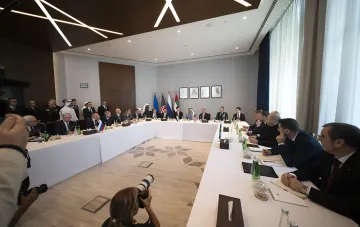
Aide to the President of Russia Yuri Ushakov stated that the inclusion of European representatives in the trilateral negotiations between the US, Russia, and Ukraine has not been definitively agreed upon with Moscow. According to him, "someone is talking about expanding the format, but this has not been coordinated with us." The official added that including European parties in the process "will require a lot of work" and that at least one more round must take place in the original trilateral format. The statement was made on November 16, 2026, and effectively called into question public statements from the American side regarding the impending expansion of the negotiation track.
Divergence in assessments of the Putin-Witkoff meeting
A key contradiction concerns what exactly was discussed at the meeting between Vladimir Putin and US Special Envoy Steve Witkoff on November 12. After the talks, Witkoff himself spoke about expanding the format to include Europe. The Kremlin did not confirm this interpretation: Dmitry Peskov noted that Moscow is not against European participation, but that a "real decision" can be made only when the Kremlin "understands their real intention and readiness to facilitate the peace process." Moreover, the Russian Foreign Ministry claimed that the issue of Europe's participation in the negotiations was not raised at all during the Putin-Witkoff meeting. Thus, the American and Russian sides describe the results of the same meeting differently.
Who will represent Europe
According to available information, the European side has already decided on the composition of the delegation: national security advisors from five countries — Germany, France, the UK, Italy, and Poland — as well as the EU's national security advisor will participate in the negotiations. At the same time, according to reports citing European diplomats, Washington and Kyiv are considering a narrower "E3" format — the UK, France, and Germany — as a group that could act on behalf of the continent, although smaller European states may consider their interests insufficiently represented. The question of which specific composition will ultimately sit at the table remains open.
Prospects for the next round
All three parties — Russia, Ukraine, and the US — confirm that the negotiations will continue, but the date for the next round has not yet been named. The Kremlin emphasizes that progress in resolving the conflict is "theoretically possible," but much depends on Kyiv's decisions, and that negotiations with the American special envoy will be "long and thorough." Experts, in particular Alexander Gabuev, director of the Carnegie Russia Eurasia Center in Berlin, estimate the likelihood of a substantive dialogue on ending the war before the end of winter as low. Against this background, the divergence in assessments of whether the issue of European participation was even brought to the table on November 12 serves as an indicator of how synchronized the parties' positions are ahead of the next round.