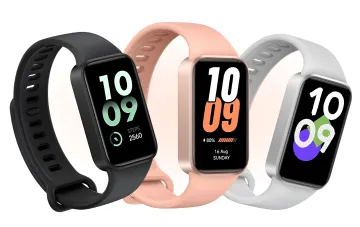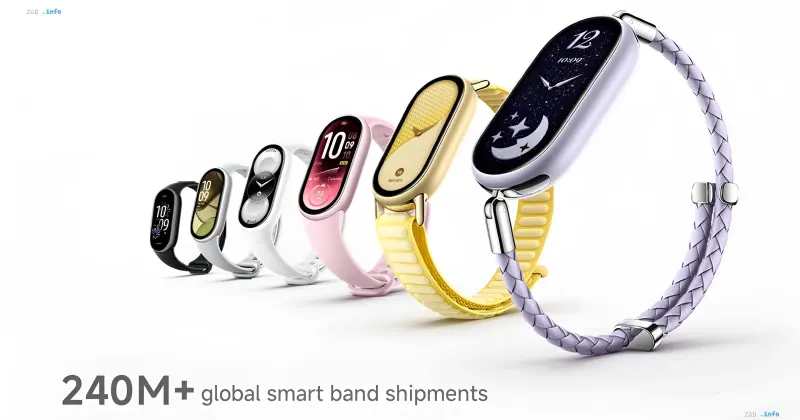
Xiaomi has announced a new milestone in its wearable technology lineup: cumulative global shipments of the company's smart bands have exceeded 240 million devices. According to analyst agency Omdia, Xiaomi (including the Redmi brand) has held the number one position in the basic fitness tracker segment for 35 consecutive quarters — from the fourth quarter of 2017 to the second quarter of 2026. This makes the Mi Band one of the longest-running and most mass-market products in the wearable category, where competition between major players is traditionally high.
Leadership in a niche segment and its boundaries
It is important to distinguish between categories: this refers specifically to basic fitness bands, not the entire wearable electronics market. In the broader category of wrist-worn devices, the picture is different. According to Omdia data for the second quarter of 2026, Huawei took first place with an 18% share, Xiaomi had 17%, and Apple held 16%. These three companies accounted for more than half of global shipments. In the separate segment of smartwatches, the Apple Watch remains the leader with a 46% share. Thus, Xiaomi's dominance is concentrated in the niche of affordable fitness bands, while the market is distributed differently in the premium and "watch" segments.
From 79 Yuan to a global hit
The company introduced the first Mi Band on July 22, 2014. The debut band priced at 79 yuan could track physical activity and sleep, supported a smart alarm, and could work for up to 30 days without recharging. It was the combination of low price, simplicity, and battery life that laid the foundation for the lineup to become one of the key pillars of Xiaomi's wearable electronics. Over more than a decade since the series launched, the lineup has expanded multiple times, and the total volume has reached the 240 million-device milestone.
Mi Band 11: the current model for the Chinese market
The current model for the Chinese market is the Mi Band 11, introduced in September 2026. The band features a 1.72-inch AMOLED screen and a 9.99 mm thick housing. The claimed battery life is 21 days, and it supports over 150 training modes. Versions with NFC, all-metal, and ceramic housings are available. The Mi Band 11 is the first in the series to run on HyperOS 4, with prices starting from 289 yuan. Thus, the company continues to increase the functionality of the line while maintaining its positioning as an accessible mass-market product.
The 240 million shipments achieved and 35 quarters of continuous leadership in the basic fitness tracker segment confirm that the Mi Band remains one of Xiaomi's most stable products in the wearables category. However, the company faces increasing competition from Huawei and Apple in the broader wearables market, where market share distribution no longer suggests singular dominance.