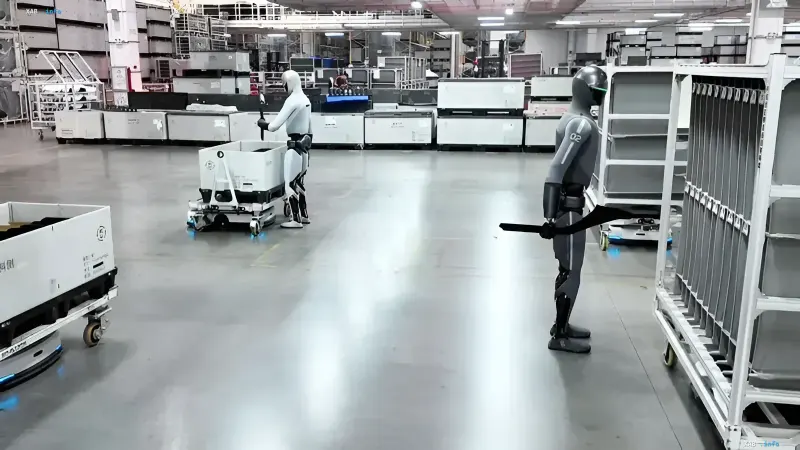
Chinese corporation Xiaomi has published a time-lapse video lasting the equivalent of a full eight-hour workday on its official X account, Xiaomi Tech, featuring two humanoid robots performing automotive component sorting operations at an active Xiaomi Auto production line. The demonstration took place directly on the shop floor under normal operational conditions rather than in isolated laboratory environments, which, according to the company, highlights the machines' readiness for real-world industrial deployment. The footage shows the robots extracting parts from containers, moving them to racks, and placing them into designated slots at the center console side trim sorting section.
What Exactly the Robots Did and How It Was Recorded
The video features an embedded working time counter and a text breakdown of the machines' operating modes. Certain segments are sped up by up to one hundred times, allowing eight hours of continuous activity to fit into a short clip. According to Xiaomi's statement, during the shift the robots did not merely mechanically repeat a preset sequence of movements, but independently detected and corrected "anomalies" during task execution while interacting with the production line management system. The company emphasizes that this very ability to autonomously correct errors and coordinate with external systems distinguishes this demonstration from simple "pick-and-place" scenarios.
What Is Missing from the Publication
Despite the impressive duration of the shown segment, Xiaomi did not disclose a number of key operational metrics. The company did not report the speed and success rate of the sorting process, the exact number of parts processed over the eight hours, the precision of component placement in the slots, or whether operator or supervisor intervention was required to resolve failures. The power supply mode also went unanswered: it remains unknown whether the robots operated for the entire eight-hour period on a single battery charge or if battery swaps were performed during the shift. The lack of these data prevents independent observers from evaluating the real performance and reliability of the machines compared to human labor in similar operations.
Context: Xiaomi's Robotics Program
The publication of the eight-hour shift is not an isolated event. Back in March 2026, Xiaomi demonstrated that its humanoid robots were capable of tightening nine out of ten nuts during an assembly line operation. At the time, the company announced plans to consistently increase the share of automated operations. The current demonstration fits logically into this trajectory: moving from point operations with a limited number of cycles to prolonged work at a separate workstation with elements of autonomous control. Xiaomi is consistently expanding the presence of embodied AI in its production chains, using its own car factory as a testing ground for refining algorithms.
What This Means for the Industry
The deployment of humanoid robots for routine sorting and component handling operations is one of the most promising scenarios for applying embodied AI in the automotive industry. Unlike rigidly fixed industrial manipulators, bipedal platforms can operate in the same spaces as humans without major shop floor reconfiguration. If Xiaomi's claimed autonomy metrics are confirmed during independent testing and over longer timeframes, this could accelerate the transition of major automakers from pilot projects to serial robotization of auxiliary operations. Nevertheless, prior to widespread industrial implementation, analysts generally agree that questions of scalability, cost of ownership, and integration with existing factory IT infrastructures remain.