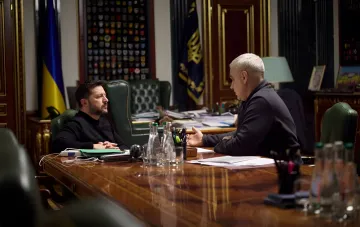
Ukrainian President Volodymyr Zelenskyy has stated the need to put a "fair and firm final period" to the history of the Khimprom criminal community. The statement was made following his meeting with Acting Prosecutor General Anton Kovalsky, where the parties discussed the progress of investigations into cases related to the syndicate's activities. According to the head of state, the inevitability of punishment must become the "best response" to the criminal activities of Khimprom and all individuals associated with it.
Results of the Meeting with the Acting Prosecutor General
According to RBC-Ukraine, Zelenskyy and Kovalsky reviewed the status of the Khimprom investigations in detail. The president emphasized that this concerns not only specific defendants, but also a systematic state response to activities that, in his estimation, harmed citizens and undermined trust in law enforcement agencies. The meeting took place against the backdrop of the ongoing search for key organizers of the community and the completion of a series of operational measures carried out in 2026.
Scale of Documented Criminal Activity
According to the National Police, Khimprom members engaged in illegal drug trafficking, committed and ordered violent crimes, and conducted fraudulent activities. Law enforcement officers documented over 30 facts of violent crimes committed or ordered by members of the group. A separate direction was a network of call centers used to defraud citizens of the Czech Republic, Romania, and Slovakia; total losses from this activity are estimated at nearly 50 million hryvnias. Another channel was a network of U420 stores selling products with synthetic cannabinoids: within a few months, the number of retail outlets grew from 13 to 105 across Ukraine.
Operational Measures and Procedural Decisions
On April 14, 2026, law enforcement officers conducted 281 searches in Kyiv and ten other regions, liquidating production, packaging, and distribution sites. The estimated value of the seized items exceeded 75 million hryvnias. Four participants were notified of suspicion under Part 2, Article 307 of the Criminal Code of Ukraine (creation of a criminal organization), and the court chose a preventive measure of detention for them. The organizer of the community continued to be sought at the time of publication. According to journalist Kateryna Kobernyk, 23 members of Khimprom's enforcement block were detained in 2025–2026, and its leader was served with two notices of suspicion.
Search for 'Mexican' and Lobbying Attempts
According to the investigation, the leader of the group is a Russian citizen nicknamed "Mexican," who was put on the international wanted list in 2019; he hid in Mexico and remotely managed the community. The National Police also reported that the leadership and operatives investigating Khimprom's activities received threats. When attempting to ban the substance sold through U420, individuals connected to the group through NGOs, lawyers, and entrepreneurs applied to the Ministry of Health and law enforcement, and also challenged the resolution in an administrative court — to no avail.