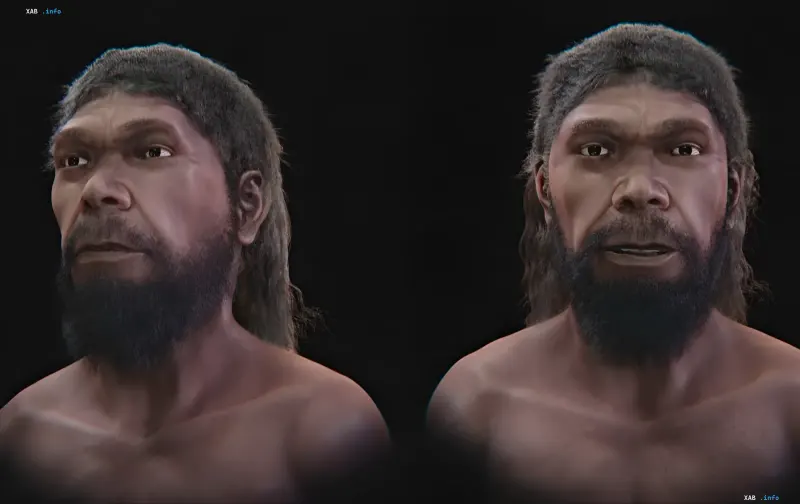
An international team of researchers has unveiled a unique 3D facial reconstruction of an individual who lived in Africa approximately 315,000 years ago. The scientific work is based on digital scans of fossil remains discovered at the famous Jebel Irhoud archaeological site in Morocco. For a long time, these finds remained a subject of intense scientific debate, but modern technologies have provided a fresh perspective on the cradle of humanity and restored the true appearance of our distant ancestors.
Background of the Discovery in Morocco
The fossil skull, known in the scientific community as Jebel Irhoud 1, was first recovered from the earth by local miners in Morocco back in 1961. Initially, anthropologists made a serious error by classifying the remains as belonging to an African Neanderthal aged around 40,000 years. This interpretation dominated the academic community for a long time until large-scale comprehensive studies in 2017 radically rewrote the generally accepted chronology of human evolution.
Study and Methodology
Comprehensive analysis proved that the remains from Jebel Irhoud actually belong to early representatives of Homo sapiens dating back over 300,000 years, making them the oldest known specimens of modern humans to date. Scientists discovered a striking anatomical feature: the facial structure and teeth of these hominins were already nearly indistinguishable from modern humans, yet the braincase retained an elongated shape typical of older archaic ancestors.
Controversial Data
Despite the revolutionary nature of the model, experts openly acknowledge certain methodological caveats. Since soft tissues and ancient DNA did not survive, researchers had to adopt a combined approach: the final composite model was created by merging fragments of several different individuals from Jebel Irhoud, while soft tissue thickness markers were borrowed from modern humans. This sparks discussions among anthropologists regarding the degree of reliability of hypothetical appearance details, such as skin pigmentation or eye shape.
Expert Assessments and Consequences
The resulting digital reconstruction is offered in two variations: a neutral grey version without hair for an objective evaluation of facial features, and a color version with the addition of hypothetical pigments. Scientists emphasize that the cranial capacity of the resulting skull reached 1,230 cubic centimeters, which completely falls within the norm of a modern adult male. The resulting outcome is recognized as the most accurate scientifically grounded approximation of what the first representatives of our species looked like on Earth.