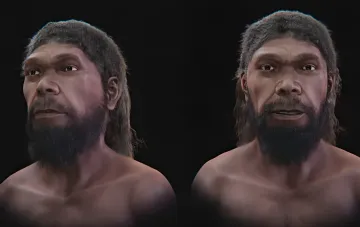
In August 2026, the scientific community is discussing a breakthrough study published in the journal Science. A team of researchers from the University of California, Berkeley (UC Berkeley) presented evidence that the modern human genome carries fragments of DNA from two previously unknown populations of ancient hominids. This discovery radically changes our understanding of Homo sapiens evolution, confirming that human history is not just a tree, but a complex web of interconnections.
The TRACE Method: Searching Without Fossils
The key to the discovery was a new analytical method called TRACE (TRacking Archaic Contributions via ARG Estimation). Traditionally, geneticists relied on sequencing DNA extracted from fossil remains to identify ancient populations. However, TRACE works differently: it analyzes genealogical connections in the DNA of hundreds of modern people, reconstructing ancestral lines without using ancient samples. Scientists constructed a recombination genealogy graph that allows tracking DNA bundles through time and identifying regions whose lineage goes unusually far back into the past.
Two Mysterious Lines: "Ghost" and "Superarchaic"
The study allowed the identification of two distinct populations that left their genetic mark. The first, called the "ghost population," diverged from the ancestors of modern humans approximately 800,000 years ago. Interbreeding with them occurred in Africa long before the massive migration of Homo sapiens into Eurasia more than 50,000 years ago. DNA from this line makes up between 0.5 and 1 percent of the genome of modern people worldwide, not just Africans, as previously assumed.
The second line, dated to 1.8 million years ago, was named the "superarchaic population." It interbred with Denisovans in Eurasia, and then Denisovans passed some of these genes to modern humans. The genome of the Denisovans themselves contains between 3 and 5 percent of such heritage, although modern humans received only a negligible portion. Scientists suggest that the "ghost" population corresponds to Middle Pleistocene Homo groups in Africa, while the superarchaic line corresponds to Homo erectus populations in Eurasia.
Evolution as a Network: Adaptation Through Mixing
The DNA fragments found are not random "junk." They are concentrated in genome regions responsible for immune and metabolic functions. This confirms the hypothesis that interbreeding with other groups helped Homo sapiens ancestors adapt to new pathogens and food sources. As co-author of the study Priya Moorjani noted, human evolution should be viewed not as a branching tree, but as a complex network of populations connected by repeated episodes of migration and mixing.
Contradictory Data
Despite the persuasiveness of the genetic data, discussions persist within the scientific community regarding the precise identification of these populations. Since the physical DNA of these ancient groups has not been sequenced, scientists are forced to rely on indirect evidence and chronology. There is a discrepancy in the exact determination of the species status of the "superarchaic" line: although data points to Homo erectus, the lack of direct comparisons with fossil material leaves room for doubt. Furthermore, the exact geography of the interbreeding of the "ghost" population in Africa remains a subject of debate, as genetic markers may point to several possible regions.
Future Research
Scientists hope that further expansion of global DNA databases and the study of proteins from Homo erectus fossil remains will finally establish the identities of these mysterious ancestors. The TRACE method opens a new era in paleogenetics, allowing the finding and mapping of genomic loci originating from lines that were considered irrevocably lost to science.