In October 2026, 59 strikes on military and industrial infrastructure targets were recorded and claimed within the territory of Russia, aviation expert Anatoliy Khrapchynsky reports in an analytical column for RBC-Ukraine. According to his data, about 60% of these targets were hit by missiles and drones manufactured by a leading Ukrainian weapons producer. Khrapchynsky emphasizes that this is no longer about isolated acts of retaliation, but rather a normalized campaign mode in which the Armed Forces of Ukraine, the Main Intelligence Directorate (HUR), the Security Service of Ukraine (SBU), and the Unmanned Systems Forces led by Madyar act in synchronization.
From Targeted Retaliation to Systematic Destruction
As the expert notes, the October list of damaged facilities demonstrates a shift in the philosophy of strikes deep into enemy territory. The priority remains the methodical destruction of the so-called "cash flow"—the fuel and energy complex that powers the Russian war machine. Strikes are carried out not only against plants in Volgograd and Ryazan, but also against deep rear facilities in Ukhta, Salavat, and other industrial centers. According to Khrapchynsky, the structure of the hit targets makes the nature of the information attacks unfolding around the domestic miltech sector in recent weeks "completely transparent."
The Sixth Domain: The Mind as a Battlefield
In NATO's classification, the human mind is officially regarded as the sixth domain of warfare—alongside land, sea, air, space, and cyberspace. The goal of cognitive war, according to the alliance's definition, is not merely to persuade an opponent of a certain point of view, but to destroy the capacity for critical thinking, flood the information space with emotions, and undermine trust in one's own institutions. Khrapchynsky points out that it is precisely in this domain, in his opinion, that Russia is waging its most active campaign against Ukrainian long-range weapon manufacturers at a time when its own industry is suffering systematic blows.
Historical Precedent: Trump's 1987 Manifesto
As an illustration of the mechanisms of reflexive control, the expert cites a case from September 1987. Immediately upon returning from Moscow, Donald Trump bought full-page ads in leading American newspapers—The New York Times, The Washington Post, The Boston Globe—for $94,801 and published an open letter demanding an end to gratuitous aid to U.S. allies. Khrapchynsky calls this episode a "textbook example" of a reflexive control operation developed by Soviet mathematician and psychologist Vladimir Lefebvre: subtly feeding the opponent such initial data and perception frameworks that they independently arrive at a conclusion beneficial to the operation's organizer and believe the idea to be their own. According to the expert, in 1987 the term "cognitive war" did not yet exist in NATO documents, but Lefebvre's theory had been developed for decades within KGB structures.
Why the Attack is Directed Against the Manufacturer, Not the Product
Khrapchynsky links the informational pressure on the Ukrainian miltech sector to a specific context: when 60% of strikes on Russian territory are provided by the products of a single manufacturer, a blow to the reputation and trust in that manufacturer becomes a tool to weaken the entire strike campaign. The expert warns that under conditions where the enemy "cannot win on the battlefield and is burning in its own rear," its bet shifts to the internal cognitive domain—to inciting mutual hatred, hysteria, and total distrust in social media. "Do not let yourselves be used as a blind tool in someone else's reflexive game," the author of the column concludes.
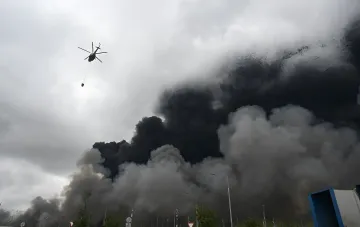
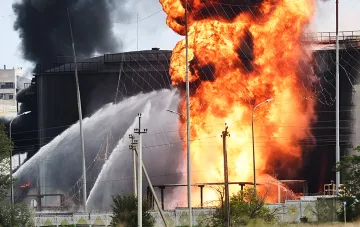
The photograph accompanying the publication captures smoke over an industrial facility at sunset—a visual illustration of the October campaign of infrastructure strikes inside Russia.