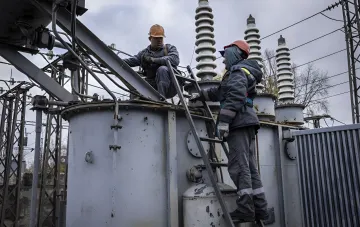
Russian strikes on Ukraine's energy infrastructure have turned blackouts from a rare event into a routine that affects residential buildings as well as offices, coworking spaces, resilience centers, and commercial facilities. In conditions where electricity can disappear for hours or even days, a laptop with sufficient autonomy becomes a critical tool for work, communication, and data access. However, even the most capacious laptop battery is not enough for the entire outage period. This is where portable power stations come to the rescue — power banks capable not only of recharging a smartphone but also providing a laptop with extra hours of operation. RBC-Ukraine has prepared a selection of seven models that allow a laptop to work longer — both for performing work tasks and for leisure in conditions of limited infrastructure.
Compact Solutions: Baseus Blade HD and AceFast M33
For those who regularly move between cafes, coworking spaces, and resilience centers, compact power banks that do not take up much space in a backpack are the optimal choice. With a thickness of about 18 mm, the Baseus Blade HD easily fits next to a laptop and offers a total power of up to 100 W on a single port with a capacity of 20,000 mAh (74 Wh). The device is equipped with two USB-C ports (input up to 65 W, output up to 100 W) and two USB-A ports (up to 30 W). When simultaneously charging a laptop and a smartphone, the power is distributed at 65 W and 30 W respectively. Included is a 1-meter 100W USB-C cable, a pouch, and an LED display showing charge level, operating time, current, and voltage. For ultrabooks like MacBook Air/Pro 13–14", Dell XPS 13, or ASUS ZenBook, the power bank provides about 0.8 full charge cycles, adding approximately 4–5 hours of operation.
Another compact option is the AceFast M33, designed for daily use. Its key advantage is the built-in 100W flat USB-C cable that can be used as a strap, eliminating the need to carry a separate laptop charging cable. The capacity is 20,000 mAh (71.1 Wh), and the maximum output power is 100 W. Additionally, it features a USB-C port up to 45 W and a USB-A port up to 22,5 W. A transparent casing element and a color display with device operation information make the model convenient to monitor. Compatibility is confirmed for Xiaomi Notebook Pro, HP Pavilion, and MacBook Air M1/M2/M3; the power bank provides about 0.75–0.8 full recharge cycles.
Mid-Range Segment: Anker Prime for Multitasking Charging
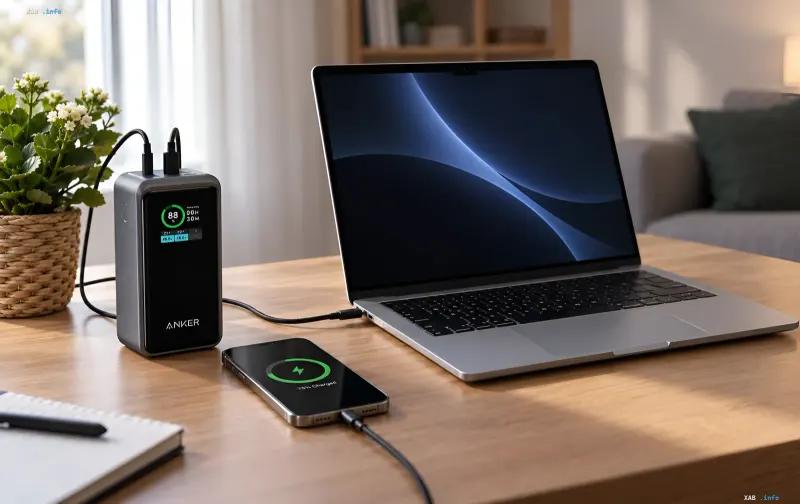
Anker Prime occupies an intermediate position between compact and flagship models. Its body is small, but its power reserve allows simultaneous charging of multiple devices. Total power reaches 200 W, up to 100 W on a single USB-C port, and capacity is 20,000 mAh (72 Wh). It features two USB-C ports (input and output up to 100 W) and one USB-A port up to 65 W. The power bank itself charges at up to 100 W in about 1 hour and 15 minutes. Included is a 100W USB-C cable, a pouch, a color TFT display with operational metrics, and Bluetooth for control via a mobile app. In terms of compatibility, the model suits ultrabooks, iPhones, iPads, and MacBook Pro 14"/16": the MacBook Pro 14" charges to 50 percent in about 40 minutes, while for the MacBook Air, the power is sufficient for one full cycle.
High-Power Models for Gaming Laptops and Workstations
For prolonged power outages and charging energy-intensive devices — gaming laptops and mobile workstations — models with greater capacity and power are required. The elongated block-shaped Cuktech 20 offers up to 140 W on a single port via the PD 3.1 standard and up to 210 W in total. Capacity is 25,000 mAh (90 Wh). Ports: USB-C1 (input up to 110 W, output up to 140 W), USB-C2 up to 60 W, USB-A up to 30 W. It comes with a 240W/6A USB-C cable, a TFT display, and light indication. The model is compatible with Lenovo Legion, ASUS ROG, Acer Predator, and MacBook Pro 16", providing about one full cycle for the latter or up to 1.3 cycles for a compact ultrabook.
The Anker 737 uses GaN architecture and is designed for charging high-power devices: up to 140 W on a single port, with a capacity of 24,000 mAh (86.4 Wh). Two USB-C ports support up to 140 W input and output, and USB-A supports up to 18 W. Included are a 140W USB-C cable, a pouch, the ActiveShield 2.0 protection system, and a color display. For business laptops like MacBook Pro 16", Dell Latitude, or ThinkPad, the power bank provides about 1.1 full charge cycles.
Maximum Capacity: Romoss PEA40 Pro for Extended Blackouts
If a power outage lasts a day or longer, capacity comes to the fore. Weighing about 900 g, the Romoss PEA40 Pro offers a capacity of 40,000 mAh (148 Wh) — one of the largest in the selection. Maximum power is up to 65 W, which is sufficient for most ultrabooks and business models. Ports: a bidirectional USB-C up to 65 W and two USB-A ports up to 22.5 W. A digital LED display shows the charge level. The model is focused on prolonged outages when compact 20,000 mAh models no longer provide a sufficient reserve.
Practical Recommendations for Choosing
When choosing a power bank for a laptop amid regular blackouts, key parameters are output power (must match the charging requirements of a specific laptop — from 45 W for ultrabooks to 140 W for gaming models), capacity in watt-hours, and the set of ports. For daily movements and short outages, 20,000 mAh models with 65–100 W power are sufficient. For prolonged blackouts and power-hungry devices, it is advisable to consider 24,000–40,000 mAh solutions with a total power starting from 140 W. All listed models are available in Ukraine starting from 2,400 hryvnias, making them an affordable tool to maintain performance under unstable power supply conditions.