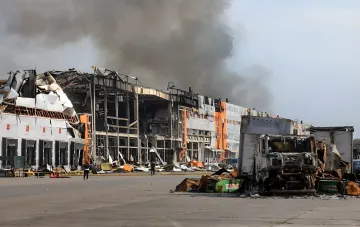
On August 7, 2026, one day after a massive attack by the Russian Armed Forces on critical infrastructure, Ukrainian businesses faced a new reality. Mark Petkevich, General Director of Novus, one of the country's largest retail chains, outlined the non-negotiable conditions for continuing operations in an exclusive comment to RBC-Ukraine. Following the missile strikes on August 5, which completely paralyzed the network's key distribution center in the Kyiv region, the company's management was forced to restructure logistics chains in emergency mode.
Three Pillars of Recovery: From Insurance to "Green Corridors"
Mark Petkevich, emphasizing the business's readiness to recover independently, noted that economic resilience is impossible without synergy with the state. In his statement, he formulated three key priorities for supporting affected enterprises. First, the creation of an effective mechanism for insuring war risks. According to the CEO, a fund involving international donors is needed to ensure transparent timelines and conditions for compensating the loss of critical assets. Only the existence of such a guarantee, Petkevich believes, will give businesses the confidence to continue investing in recovery.
The second critically important direction identified is accessible financing. Retailers are calling for the introduction of preferential or interest-free targeted loans for enterprises whose infrastructure was destroyed by shelling. The goal of such measures is to prevent delays in resuming operations, which could drag on for years at current market rates. The third point of the rescue program was the simplification of imports. Petkevich proposed introducing "green corridors" at the borders and temporarily reducing customs duties on basic food products to avoid shortages and curb price increases for the population.
Logistical Collapse and the Price of a Silent Sky
The attack on August 5, 2026, was a shock to the logistics sector. Direct missile hits on the Novus distribution center led to a complete shutdown of the facility, requiring the immediate redistribution of inventory between other warehouses. Market experts note that the speed of goods delivery becomes critical when the domestic market is under constant attack. However, despite requests for financial and administrative support, market participants emphasize that the main condition for survival remains the strengthening of air defense. Without reliable sky protection, any support measures will have limited effect, as assets will be destroyed faster than they can be restored.
Contradictory Data
There are discrepancies in assessments regarding the mechanisms for supporting businesses after the attacks on August 5. On the one hand, business representatives, including Mark Petkevich, insist on the lack of real mechanisms for insuring war risks for warehouse real estate and inventory, demanding the creation of new structures with international partners. On the other hand, the government states that information on losses is already being collected and existing assistance programs are operational. However, experts point out that current tools do not cover the scale of damage from the 2026 missile strikes, creating a gap between business expectations and the state's actual capabilities.