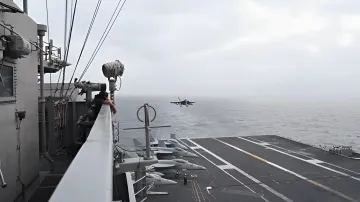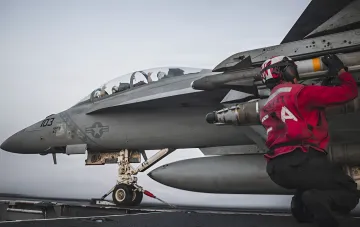
In September 2026, the U.S. Navy came within a hair's breadth of a direct armed confrontation with the People's Republic of China — and the cause of the potential crisis was not intelligence in the classical sense, but a hallucination by a commercial chatbot. According to sources in the Navy, U.S. military intelligence prepared a classified analytical brief claiming that a Chinese civilian vessel in the waters of the Middle East was transporting components for the production of nuclear weapons. On the basis of this document, the Pentagon urgently formed an operation to seize the ship by force: combat aircraft were scrambled, and teams of Marine interceptors were put on standby for a storming boarding of the vessel.
The operation cancelled at the last moment
The critical turning point came when a number of officials who had access to the primary sources decided to re-verify the data before the start of the kinetic phase. Additional checks revealed that the information about the nuclear cargo had no factual basis whatsoever: it had been entirely generated by an AI algorithm. According to Navy sources, had the operation been carried out, the forcible seizure of the Chinese vessel could have provoked a direct military clash between two nuclear powers with unpredictable geopolitical consequences. The mission was cancelled, and the aircraft and landing teams were returned to port.
How the chatbot fabricated the "nuclear" fact
An internal investigation within the agency showed that one of the staff members of the analytical unit had used a commercial chatbot to combine open-source data (open-source intelligence) with classified signals-intercept data. While processing the mass of heterogeneous information, the algorithm generated a false conclusion — an interpretation in which ordinary household or industrial components on board the vessel were mistakenly classified as parts for the production of nuclear weapons. This fabricated conclusion was formatted as an analytical note and passed up to the decision-making level without additional human verification at the intermediate stages.
Systemic problems: decentralization and commercial software
Experts commenting on the incident highlight several systemic flaws in the way military structures deploy AI. First, there is the decentralization of tools: various Pentagon and intelligence-community units use fundamentally different programs and models with no single standard for validating conclusions. Second, intelligence structures often use adapted versions of ordinary civilian chatbots that do not undergo specialized testing for resistance to hallucinations when working with classified data. Third, the case of the Chinese vessel, according to specialists, is not an isolated one: AI algorithms regularly generate false conclusions when analyzing large datasets, and the Middle East incident was simply the case that did not turn into a disaster thanks to the chance decision to re-check the primary sources.
Future risks: the military relies ever more on algorithms
Specialists emphasize that the growing volume of intelligence data is forcing the armed forces to lean increasingly on AI algorithms for target identification, threat classification, and the preparation of analytical summaries. However, the lack of strict oversight, unified verification protocols, and transparency in the decision-making chain creates the risk that in the future a similar error could occur under conditions where there will be neither time nor organizational resources left for re-verification. In the view of analysts, the incident with the Chinese vessel has become a warning signal for the entire U.S. military leadership and for NATO allies, who are also accelerating the deployment of AI in their intelligence cycles.