AMD has introduced MEXT, a technology that allows large server systems to significantly reduce operating memory costs. The mechanism moves infrequently used data from expensive DRAM to significantly cheaper SSD storage, while machine learning algorithms ensure this does not lead to a noticeable drop in performance. Across the first 145 server systems, the company estimated the achieved savings at approximately $5 million.
Memory as the Primary Server Expense
According to AMD Vice President of Business Development Gary Smerdon, who previously led the MEXT project, RAM modules in large servers can account for 60 to 90% of the cost of the entire hardware. Replacing part of DRAM with cheaper flash memory makes it possible to reduce costs without necessarily decreasing the amount of memory available to applications. It was precisely this price disparity that determined the direction of development.
The Performance Gap Challenge
The key complexity lies in the performance difference between memory types. According to Smerdon's estimation, flash memory can be 50 times cheaper than DRAM per bit and consume 30 times less energy, yet operate roughly 500 times slower. Ordinary data offloading to SSDs can severely slow down applications, especially latency-sensitive ones, making simple data "shuffling" without intelligent management unacceptable.
How MEXT Works
MEXT utilizes a machine learning model that tracks memory accesses and attempts to predict which data pages the processor will need next. Inactive pages are moved to storage, and returned to DRAM before a repeated access. For the operating system and applications, this process must remain transparent, which ensures the seamless operation of the mechanism.
Prediction Based on Transformer Architecture
At the core of the prediction mechanism lies a model derived from the Transformer architecture. Instead of the next word, as in language models, it predicts the next demanded memory page. According to Smerdon, initial training takes less than a second on a single EPYC processor core, after which the model continues adapting to the workload pattern. A separate graphics accelerator is not required for its operation.
Results Depend on the Application
Performance figures depend heavily on the specific application. In AMD tests, a system running Apache Spark maintained 99% of its original performance when half of the DRAM was replaced with flash memory. In the Synopsys PrimeTime suite, a similar configuration provided 95% performance, and when physical DRAM was reduced to a quarter of its initial volume, the figure dropped to 80%.
Internal Deployment and Estimated Savings
AMD also published the results of MEXT's internal deployment. Across 86 company servers, the software provided about 58 TB of additional available memory. Purchasing a comparable volume of DRAM would have cost roughly $3.3 million, whereas the deployment costs of MEXT amounted to about $601,000. Thus, the estimated savings reached $2.78 million, or 82% of the cost of traditional memory expansion.
Availability, Partners, and Context
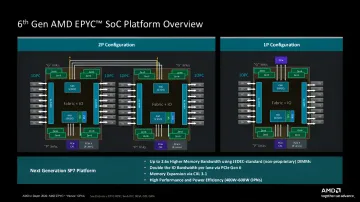
The software is intended primarily for servers running AMD EPYC processors. On Linux systems, a kernel module is provided for its operation, and the RAM View utility is offered for workload analysis. AMD is collaborating with server manufacturers, including HPE, to prepare hardware for MEXT usage, and commercial licensing distribution through partners is scheduled for the next deployment phase. AMD itself acquired the MEXT developer in June 2026, and the technology's capabilities were showcased alongside EPYC Venice server processors based on the Zen 6 architecture.