Autumn is traditionally considered the time for apple baking, and in October, when firm sweet-and-sour varieties appear on the shelves, open apple pie becomes one of the most sought-after homemade desserts. However, classic recipes are often intimidating: shortcrust pastry requires time for kneading and chilling, and shaping edges or folding crusts over fruits takes separate skill. In an article by Styler, the editor offers a simplified version inspired by culinary author Olivia Kaplan's recipe, where the entire process — from unfolding the pastry to the finished pie — takes about 45 minutes, while complex filling preparation and dough mixing are completely eliminated.
From Shortcrust to Puff Pastry: How the Original Recipe is Adapted
The basis is taken from Olivia Kaplan's open apple tart, which is made with shortcrust pastry, apples, raisins, butter, cinnamon, and almond flour. Originally, the filling is placed in the center of a round sheet, and the free edges are folded over the fruits; baking takes 40–45 minutes at 200°C in convection mode. The editor's adapted version replaces shortcrust pastry with ready-made puff pastry, changes the shape to rectangular, reduces the amount of butter, adds sugar, and replaces almond flour with cornstarch. It is these changes that turn the recipe into a quick one: the pastry is already ready to use, and the rectangular format does not require shaping edges.
Pastry and Baking Sheet Preparation
For the quick version, ready-made rolled puff pastry is suitable — most conveniently a chilled rectangular sheet weighing about 275 g and measuring roughly 25 by 40 cm. If the pastry is frozen, it is thawed according to the manufacturer's instructions, and the thawing time is not included in the stated 45 minutes. The oven is preheated to 200°C in top-and-bottom heat mode. The sheet is unrolled on a baking sheet lined with parchment paper, leaving a free edge about 2 cm wide around the perimeter, and the middle is lightly pricked with a fork without touching the edges to reduce excessive rising of the central base. One such sheet yields about 6–8 servings depending on the size of the pieces.
Filling: Apples, Raisins, and Starch Against Moisture
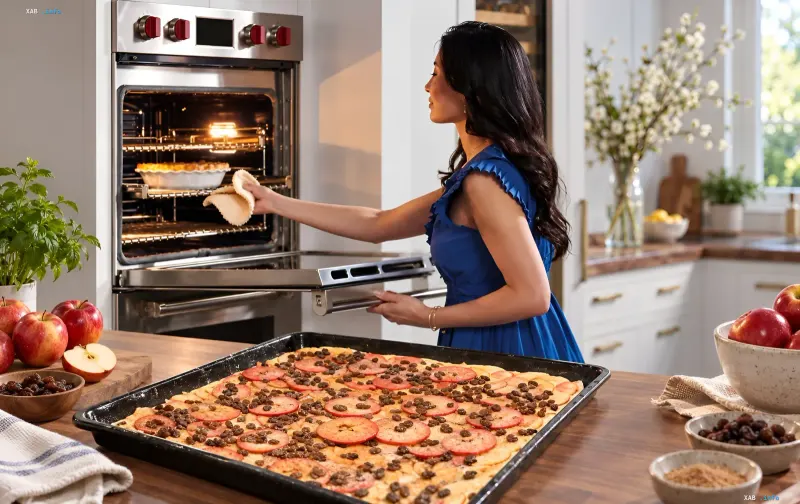
Firm sweet-and-sour apples that do not lose their shape during baking are chosen for the filling. The apples are washed, cored, and sliced into thin circles or half-circles 2–3 mm thick; the skin can be left on if it is thin. The raisins are thoroughly washed, soaked in warm water for 5–10 minutes if necessary, then dried with a paper towel so that excess moisture does not get onto the pastry. The middle of the pastry is sprinkled with cornstarch, which binds part of the apple juice, and the slices laid out in rows slightly overlap each other without forming too thick a layer so the base can bake through. On top, the filling is sprinkled with a mixture of sugar and cinnamon, and small pieces of butter are distributed over the apples.
Baking and Doneness Control
The free edges of the pastry are brushed with beaten egg, while the filling is not brushed. The baking sheet is placed on the middle rack of the preheated oven and baked at 200°C in top-and-bottom heat mode for about 25–35 minutes; the exact time depends on the oven's features, pastry thickness, and amount of apples. The finished pie should have golden browned edges and a baked base, while the apples should become soft but retain their shape. If the top browns prematurely and the base is not ready yet, the pie is loosely covered with foil and baking continues, periodically checking the pastry. After baking, the pie is cooled for 10–15 minutes, during which the filling stabilizes and the pastry is easier to cut into rectangular portioned pieces.
The Main Secret: Combating Excess Moisture
One of the main difficulties of open fruit pies is excess moisture in the filling: apples release juice when heated, which can leave the bottom of the pastry slightly soggy. To avoid this, the fruits are not laid out in too thick a layer and a small amount of cornstarch is used. Roughly speaking, preparation with ready-made chilled pastry takes 10–15 minutes, baking takes 25–35 minutes, totaling about 45 minutes from start to a ready dessert, which is convenient to serve with tea on cool autumn evenings.